

What Is Studio Pottery? A Complete Beginner's Guide
Studio pottery is defined as ceramics handcrafted by an individual artist or small team who controls every stage of production, from clay selection through firing, resulting in unique or limited-edition pieces rather than mass-produced ware. The Victoria and Albert Museum frames this as a practice where artistic integrity takes priority over output volume. That single distinction separates studio pottery from nearly every other category of ceramic art. If you want to understand what ceramic art looks like at its most personal, studio pottery is the place to start.
What is studio pottery and how is it defined?
Studio pottery is ceramics produced by a single potter or small team controlling all production stages, including design, clay preparation, throwing or hand-building, glazing, and kiln firing. The result is a limited quantity of pieces, each carrying the visible marks of its maker. That individuality is not a flaw. It is the point.
The studio pottery definition stands apart from the broader category of ceramic art because it demands hands-on oversight at every step. A ceramic artist might delegate glazing or rely on a production team. A studio potter does not. This singular control is what gives each piece its character and its market value.
The arts and crafts movement of the late 19th century planted the seeds of this philosophy. Studio ceramics reject commercial mass-production as a matter of principle, not just practice. That philosophical stance is core to why collectors pay a premium for studio work over factory-made alternatives.
How does studio pottery differ from industrial and art pottery?
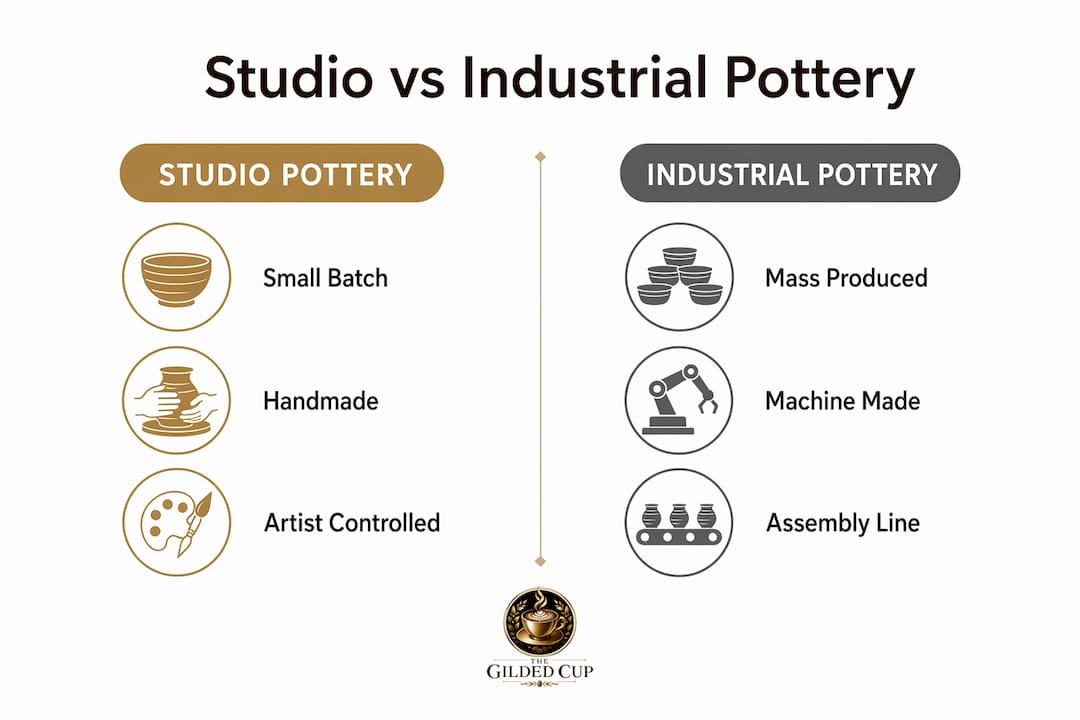
The clearest way to understand studio pottery is to compare it against what it is not. Industrial pottery divides labor across specialists: one person throws, another glazes, another fires. Studio pottery collapses all of those roles into one person or a tightly coordinated small team.
The line between studio pottery and art pottery is sometimes blurred, but hands-on artist oversight of every production phase is the defining test. Commercial art pottery often involves assistants or assembly-style processes. Studio potters manage clay sourcing, throwing, glaze formulation, and kiln control personally. That is a meaningful difference in both process and outcome.
| Characteristic | Studio pottery | Industrial pottery |
|---|---|---|
| Production scale | Small batch or one-of-a-kind | High volume |
| Creative control | Single artist or small team | Divided across specialists |
| Aesthetic variation | Intentional, piece to piece | Minimized for consistency |
| Typical use | Collectible, functional art | Everyday commercial ware |
| Anti-industrial ethos | Central to identity | Not a factor |
Pro Tip: When evaluating a piece, look for slight asymmetry, fingerprint impressions, or glaze pooling. These are signs of genuine studio work, not defects.
Studio pottery also differs from industrial ware in its relationship to premium craftsmanship. Factory ceramics prioritize uniformity. Studio ceramics prioritize expression. That gap in philosophy produces a gap in experience for anyone who handles both.
What clay types and firing techniques do studio potters use?
The three primary clays in studio pottery are earthenware, stoneware, and porcelain. Each fires at a different temperature and absorbs moisture at a different rate, which directly shapes what a piece can do and how it looks.
- Earthenware fires at 1,830–1,945°F with a 10–15% absorption rate. It is the most forgiving clay for beginners and produces warm, rustic surfaces. Its higher porosity means it is less suited for food-safe functional ware without a tight glaze seal.
- Stoneware fires at 2,232–2,345°F with a 2–6% absorption rate. Stoneware offers the best balance of durability, workability, and suitability for functional dinnerware. Most studio potters working in functional ware reach for stoneware first.
- Porcelain fires at 2,280–2,420°F with a 0–1% absorption rate. It produces the most refined, translucent surfaces but demands the most technical skill. A full guide to porcelain’s properties shows why collectors prize it for both beauty and food safety.
Firing method matters as much as clay type. Electric kilns give studio potters precise temperature control and are the most common choice for beginners. Gas kilns introduce atmospheric variation through reduction firing, which creates unpredictable surface effects that many potters prize. Wood kilns, including the Japanese anagama style, fire over multiple days and deposit ash directly onto the clay, producing surfaces impossible to replicate any other way. Raku firing involves removing pieces from the kiln while still glowing hot and placing them in combustible material, creating dramatic metallic and crackle effects.
Mastering high-fire techniques at 1,200–1,300°C requires specialized kiln equipment and deep knowledge of glaze chemistry. That technical threshold is what separates hobbyist work from professional studio pottery.
Pro Tip: Glaze chemistry is not optional knowledge for serious studio potters. A glaze that looks correct at cone 6 can blister, crawl, or leach at cone 10. Test every new glaze recipe on sample tiles before committing to a full firing.
How did studio pottery develop and who shaped it?
Studio pottery emerged in the early 20th century as a direct anti-industrial craft movement, born from frustration with factory production stripping the maker’s hand from the finished object. Its development followed a clear arc shaped by a handful of key figures and cultural exchanges.
- Bernard Leach established his pottery in St. Ives, England, in 1920 after studying in Japan. He brought Japanese and Korean ceramic philosophies to Western practice, arguing that functional pottery could be fine art.
- Shoji Hamada, Leach’s collaborator, became a Living National Treasure in Japan and demonstrated that studio pottery could carry the weight of cultural identity, not just aesthetic preference.
- The Bauhaus movement in Germany ran parallel to Leach’s work, treating ceramics as a discipline where art and craft were inseparable. This reinforced the idea that the maker’s full involvement was non-negotiable.
- Lucie Rie and Hans Coper pushed studio pottery toward modernism in the mid-20th century, introducing refined forms that challenged the rustic aesthetic Leach championed.
- Contemporary practitioners have expanded the field further, moving studio ceramics into large-scale sculpture, public installation, and multi-piece assemblages that reflect narrative and cultural identity.
The fusion of Eastern and Western ceramic traditions that Leach and Hamada initiated is still visible in studio pottery today. Many potters work with Japanese wood-firing techniques alongside Western glaze traditions, producing work that belongs to neither tradition exclusively.
What is the artistic and cultural significance of studio pottery today?
Studio pottery functions as a direct response to industrial uniformity. Every handmade piece carries what the Victoria and Albert Museum calls the visible trace of the maker, a quality that machine-made objects cannot replicate. Collectors and curators treat this as a core value, not a sentimental preference.
The field has moved well beyond mugs and bowls. Contemporary studio pottery now encompasses large-scale sculptures, public installations, and multi-piece assemblages that function as fine art in gallery and museum contexts. Clay has proven itself as a medium capable of carrying complex ideas about identity, memory, and place.
“The pot is not a vessel for liquid. It is a vessel for the maker’s intention.” This idea, central to the studio pottery movement since Leach’s time, explains why a handmade bowl commands a price that a factory bowl never will.
Studio pottery also plays a role in cultural identity. Indigenous ceramic traditions in the American Southwest, Japanese mingei folk pottery, and West African vessel-making have all influenced and been influenced by the studio pottery movement. The result is a field that is genuinely global while remaining deeply personal.
The boundary between functional ware and fine art continues to blur. A studio-made cup displayed in a home ceramics collection occupies the same space as a painting or sculpture. It is used, handled, and looked at. That dual life is unique to ceramics among the visual arts.
Key takeaways
Studio pottery is the most personal form of ceramic art because one artist controls every decision from raw clay to finished glaze, producing pieces that carry irreplaceable individuality.
| Point | Details |
|---|---|
| Studio pottery definition | One artist or small team controls all production stages, from clay to kiln. |
| Clay selection matters | Stoneware suits most potters; porcelain demands more skill but delivers finer results. |
| Firing method shapes the surface | Wood, gas, and raku kilns produce effects that electric kilns cannot replicate. |
| Historical roots run deep | Bernard Leach and Shoji Hamada built the movement by fusing Eastern and Western traditions. |
| Art and function coexist | Studio pottery ranges from everyday dinnerware to gallery-scale sculpture and public installation. |
Why studio pottery rewards closer attention than most people expect
I have spent years around fine ceramics, and the question I hear most often is some version of: “Why does this handmade mug cost ten times more than a store-bought one?” The answer is not marketing. It is accountability.
A studio potter cannot blame a production line when something goes wrong. Every crack, every crawled glaze, every warped rim is theirs. That accountability produces a different quality of attention than any factory system can replicate. When you hold a well-made studio piece, you are holding the result of hundreds of small decisions made by one person who cared about the outcome.
What surprises most newcomers is how much science sits underneath the art. Glaze chemistry, kiln atmosphere, clay body formulation. These are not intuitive skills. A potter who understands why iron oxide behaves differently in reduction versus oxidation firing has earned that knowledge through failure, not reading. That depth is what separates a limited-edition ceramic worth collecting from a decorative object worth displaying.
My honest advice: handle studio pottery before you buy it. The weight, the texture, the way a rim meets your lip. These things do not show up in photographs. Studio pottery is a tactile art form first. Everything else follows from that.
— Sharbel
Thegildedcup and the world of studio ceramics
Thegildedcup curates a selection of artisan ceramics and fine drinkware for collectors and enthusiasts who want pieces that carry genuine craft behind them. The platform brings together works where material quality, firing technique, and maker intention are all part of the story.

Whether you are building a collection or looking for a single piece that stands apart from mass-market options, Thegildedcup’s ceramic collection offers a starting point worth exploring. The site also publishes guides on ceramic art, display, and collecting for readers who want to deepen their knowledge before committing to a purchase. Studio pottery deserves to be lived with, not just admired from a distance.
FAQ
What is the studio pottery definition in simple terms?
Studio pottery is ceramics made by one artist or a small team who personally handles every step, from shaping the clay to firing the finished piece. The goal is artistic expression and individuality, not volume.
How does studio pottery differ from regular pottery?
Regular or industrial pottery divides production across multiple workers to maximize output and consistency. Studio pottery keeps all decisions with one maker, producing pieces that vary intentionally from one to the next.
What clay is best for studio pottery beginners?
Stoneware is the most practical starting clay because it offers durability, moderate firing ease, and suitability for functional pieces like mugs and bowls. Earthenware is more forgiving to work with but less durable for everyday use.
Who are the most important figures in studio pottery history?
Bernard Leach and Shoji Hamada are the foundational figures, credited with establishing the studio pottery movement in the early 20th century by blending Japanese and Western ceramic traditions into a coherent artistic philosophy.
Can studio pottery be considered fine art?
Studio pottery crosses into fine art when the maker prioritizes expression over function, and contemporary studio ceramics now include large-scale sculptures and public installations shown in galleries and museums worldwide.