

What Is Murano Glass? History, Craft, and Authenticity
Murano glass is defined as handcrafted artisan glassware produced exclusively on the island of Murano in the Venetian lagoon, Italy, following an unbroken tradition of more than 700 years. The craft traces its formal origin to a 1291 Venetian decree that relocated all glass furnaces from Venice to Murano to reduce fire risk and protect trade secrets. Techniques like cristallo, millefiori, and aventurine were born on this island and remain its signature. Brands such as Venini, Barovier & Toso, and Seguso have carried those traditions into the modern luxury market. No other glassware tradition combines this depth of history, technical complexity, and geographic exclusivity in a single object.
What is Murano glass and why does it matter?
Murano glass is the recognized industry term for a specific category of handmade glass art, distinct from mass-produced Venetian-style glass sold globally. The difference is geographic and technical. Only glass made by certified artisans on Murano island qualifies as authentic Murano glass. Everything else is an imitation, regardless of how it looks.
The craft matters because it represents one of the longest continuous artisan traditions in Western art history. Venetian glassmakers were relocated to Murano in 1291 by order of the Great Council of Venice, concentrating centuries of knowledge on a single island less than two square miles in size. That concentration created an environment where technique was passed from master to apprentice without interruption across generations.
Collectors and art enthusiasts prize Murano glass not just for its beauty but for what each piece represents. A single vase or chandelier carries the accumulated knowledge of dozens of generations of glassmakers. That is a rare thing in any art form.
What is the history of Murano glass?
The story of Murano glass unfolds in distinct chapters, each defined by a shift in technique, politics, or artistic ambition.
-
The 1291 relocation. The Venetian government ordered all glassmakers to move their furnaces to Murano, citing fire risk in the densely built city. The real motivation was also secrecy. Venice’s glass trade was enormously profitable, and the government wanted to control it completely. Glassmakers gained unusual social privileges in exchange for their confinement, including the right to wear swords and to marry into Venetian nobility.
-
The golden age of the 15th and 16th centuries. This period produced the craft’s most celebrated innovations. Angelo Barovier, a master glassmaker from one of Murano’s most prominent families, developed cristallo, a nearly colorless, highly transparent glass that was unprecedented in Europe at the time. The 15th and 16th centuries also saw the refinement of millefiori, a technique that fused patterned cane slices into glass to create floral mosaic designs.
-
Strict controls and enforced secrecy. The Venetian state treated glassmaking knowledge as a state secret. Artisans who attempted to leave and share their techniques abroad faced severe penalties, including threats against their families. This isolation, paradoxically, drove intense technical innovation because artisans competed fiercely within the island’s closed community.
-
Expansion into mirrors and chandeliers. By the 17th century, Murano glassmakers had mastered large flat mirror production and elaborate chandelier construction. These products became symbols of European aristocratic wealth and spread Murano’s reputation across royal courts from Paris to St. Petersburg.
-
Modern legacy brands. The evolution of Murano glass from early beads and mirrors to complex artistic production gave rise to internationally recognized brands. Venini, founded in 1921, and Barovier & Toso, tracing its roots to the 14th century, remain the most cited names in the global collectible glass market.
How is Murano glass made?
The glassmaking process begins with raw materials: silica sand, soda, and lime form the base. Artisans add metal oxides to produce specific colors. Cobalt produces deep blue, gold chloride creates ruby red, and manganese yields violet. The mixture is heated above 1,400°C until it becomes a molten, workable mass.
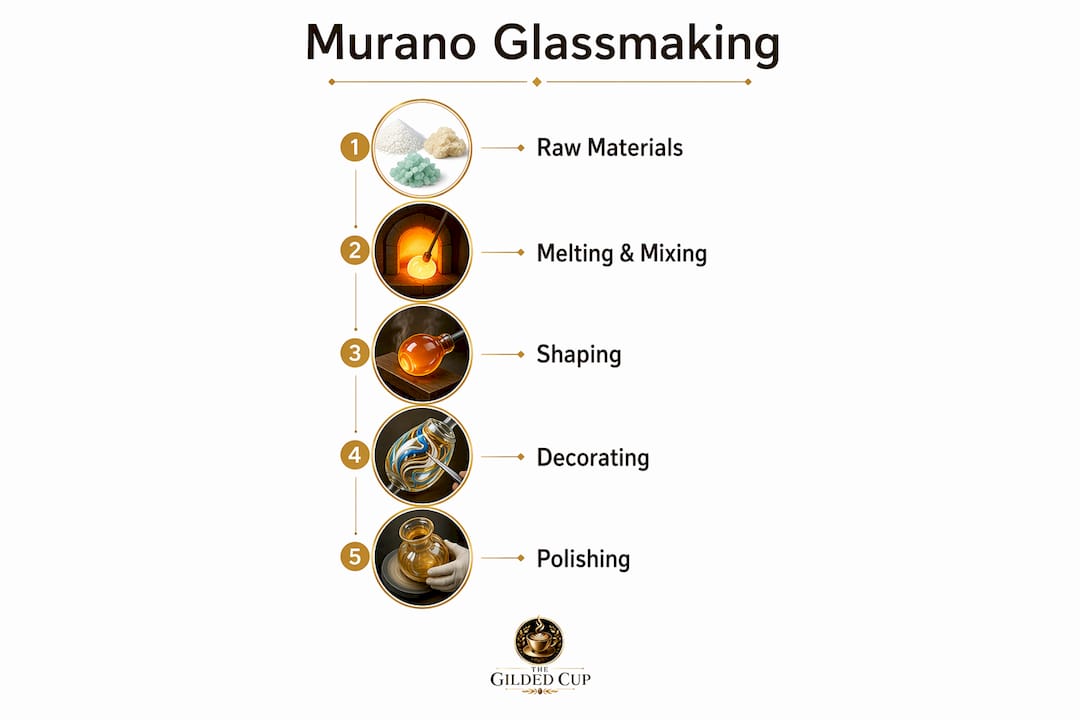
From that point, time becomes the master’s most demanding constraint. Molten glass cools rapidly and becomes unworkable within minutes. Every movement must be deliberate and fast.
Core shaping techniques
- Blown glass: The maestro gathers molten glass on a blowpipe and inflates it into a bubble, shaping it by rotation, gravity, and tools while an assistant manages the pipe’s angle and temperature.
- Mold-blown: Glass is blown into a carved mold to achieve precise repeatable shapes, then finished freehand.
- Freehand shaping: Using metal pincers, paddles, and shears, the team sculpts the molten form directly without a mold. This produces the most distinctive and irregular pieces.
Decorative techniques that define the craft
Millefiori consists of thin slices cut from patterned glass canes, fused into the surface or body of a piece to create floral or mosaic patterns. Aventurine glass incorporates tiny flakes of copper or gold leaf suspended inside the glass, creating a sparkling, starfield effect. Lattimo produces an opaque, milk-white glass achieved through the addition of tin or arsenic compounds. Sommerso layers multiple colors of glass one inside another, creating a sense of depth that looks almost three-dimensional.
Pro Tip: The maestro does not work alone. Murano glassmaking is a team-coordinated process where three to five artisans work in synchronized roles around a single furnace. The myth of the solitary master is romantic but inaccurate. Breakages are common, and that shared risk is precisely why authentic pieces command premium prices.
What characteristics distinguish authentic Murano glass?
Authentic Murano glass carries physical evidence of its handmade origin. These marks are not flaws. They are proof.
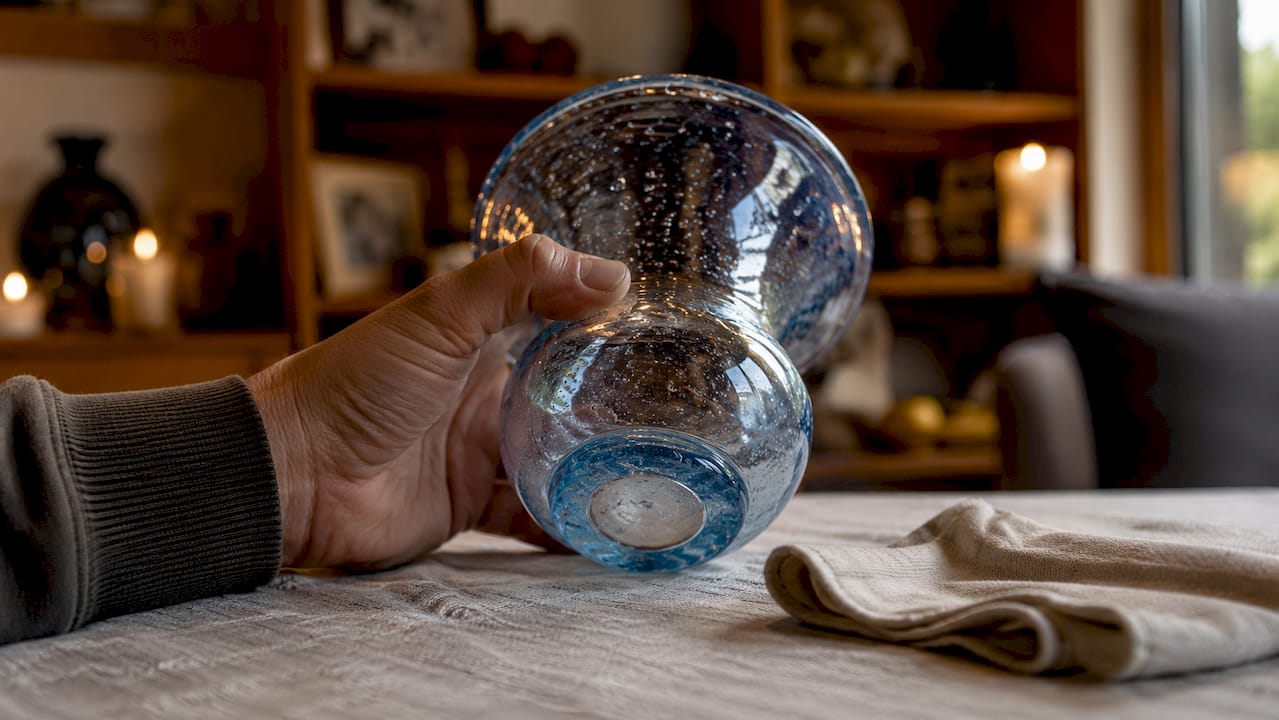
Small imperfections such as air bubbles, slight asymmetry, and pontil marks on the base are standard features of genuine pieces. A pontil mark is the small rough spot left where the iron rod used to hold the piece during shaping was broken away. Industrial glass never has this mark because machines do not use pontil rods.
Cold-working marks are equally telling. After a piece is formed, artisans grind and hand-polish the base and edges. Cold-working signs include fine grinding traces and a slightly matte finish on polished surfaces. These are subtle but consistent across authentic work.
Pro Tip: Signatures can be forged. Etched names and paper labels are easy to replicate. Collectors who know the craft trust cold-working marks and physical construction details over any signature. When you buy Murano glass online or in person, ask the seller specifically about pontil marks and cold-working evidence before relying on a label.
| Point | Authentic Murano glass | Imitation glass |
|---|---|---|
| Pontil mark | Present on base | Absent or machine-simulated |
| Air bubbles | Small, irregular, naturally occurring | Absent or uniform |
| Color depth | Rich, layered, complex | Flat, uniform, printed |
| Base finish | Hand-polished with grinding traces | Machine-smooth |
| Symmetry | Slight natural variation | Perfect machine uniformity |
| Certification | Vetro Artistico® Murano trademark | No verifiable origin mark |
How does Murano glass maintain its cultural and economic importance today?
Murano glass today functions as both a living craft and a global luxury category. The island draws hundreds of thousands of visitors annually, and its furnaces remain active with working maestros producing pieces sold to collectors worldwide.
Several factors sustain its contemporary relevance:
- Legal trademark protection. The Vetro Artistico® Murano trademark certifies that a piece was produced on Murano island by registered artisans. This certification system was created specifically to combat the flood of imitation glass sold under the Murano name in tourist markets and online.
- Established luxury brands. Venini, Barovier & Toso, and Seguso continue to produce collectible works that appear in major auction houses and museum collections. Their pieces appreciate in value over time, placing Murano glass firmly in the fine art investment category.
- New designers working within tradition. A generation of contemporary designers has collaborated with Murano maestros to produce work that respects historical technique while addressing modern aesthetics. This keeps the craft from becoming a museum piece.
- Collector engagement. Serious collectors study specific families of technique, particular maestros, and historical periods. Knowing why rare glassware holds value over time is part of what separates informed buyers from casual tourists.
The economic ecosystem around Murano glass extends well beyond the island itself. Auction records, gallery exhibitions, and curated online platforms have made it possible to build a serious collection without ever visiting Venice.
Key takeaways
Murano glass is irreplaceable because its value is inseparable from the specific place, people, and unbroken tradition that produced it.
| Point | Details |
|---|---|
| Geographic exclusivity | Only glass made on Murano island by certified artisans qualifies as authentic. |
| Historical depth | The craft traces to a 1291 Venetian decree and over 700 years of continuous technique. |
| Handmade evidence | Pontil marks, air bubbles, and cold-working traces confirm genuine artisan production. |
| Authentication over signatures | Cold-working marks are more reliable than etched names, which are easily forged. |
| Living luxury market | Brands like Venini and Barovier & Toso keep Murano glass active in global collector markets. |
Why I think most people underestimate what they’re holding
Most people who encounter Murano glass for the first time see a beautiful object. That is the right reaction. But it stops too soon.
What I find genuinely striking about this craft is the physics of it. The team around a furnace has a window of perhaps two to three minutes to shape a piece before the glass becomes unworkable. Every movement is choreographed not by a script but by years of shared practice. When a piece breaks, and breakages are frequent, the entire team absorbs that loss. That shared risk is baked into the price of every authentic piece you hold.
I also think the authentication conversation gets distorted by the signature obsession. Buyers fixate on etched names and paper certificates when the real story is written in the base of the piece. A hand-polished pontil mark tells you more about a piece’s origin than any label ever will.
The tension between tradition and contemporary design is the most interesting thing happening in Murano right now. Some purists resist collaboration with outside designers. I think that resistance misunderstands what kept the craft alive through five centuries of political upheaval and industrial competition. It was always the willingness to push technique into new territory, not the preservation of old forms. The maestros who built the golden age were innovators, not curators.
If you are building a collection or simply want to understand what you are buying, learn to read the object itself. The designer glassware tradition rewards that kind of attention more than almost any other art form.
— Sharbel
Discover authentic Murano glass at Thegildedcup
Thegildedcup curates a selection of luxury and collectible glassware for buyers who care about what they own. Whether you are building a serious collection or searching for a piece that carries genuine artisan history, the platform offers detailed product information, high-quality imagery, and purchasing options suited to international buyers.

Thegildedcup’s approach to luxury glassware reflects the same standard this article describes: provenance matters, craftsmanship is verifiable, and beauty should come with a story worth knowing. For collectors who want to go deeper, the platform also provides guidance on caring for your glassware to preserve the brilliance of every piece you acquire.
FAQ
What is the difference between Murano glass and Venetian glass?
Murano glass is produced exclusively on Murano island by certified artisans, while Venetian glass is a broader term often applied to glass made in Venice or in the Venetian style anywhere in the world. Only pieces made on Murano island can carry the Vetro Artistico® Murano trademark.
How can I tell if Murano glass is authentic?
Look for a pontil mark on the base, slight asymmetry, natural air bubbles, and hand-polished cold-working traces. These physical signs are more reliable than signatures or paper labels, which are easily replicated.
Why is Murano glass so expensive?
The price reflects the labor-intensive team process, high breakage rates, centuries of refined technique, and geographic exclusivity. A single piece can require three to five artisans working in precise coordination within a narrow time window before the glass cools.
What are the most famous Murano glass techniques?
Millefiori, aventurine, lattimo, and sommerso are the most recognized techniques. Millefiori fuses patterned cane slices into floral designs, while sommerso layers multiple glass colors to create internal depth.
Can I buy authentic Murano glass online?
Yes, but you should purchase from sellers who provide specific provenance details, including the Vetro Artistico® Murano certification, physical descriptions of pontil marks, and clear documentation of the producing artisan or brand.