

What is limited edition ceramics: a collector's guide
The “limited edition” label gets applied to everything from mass-produced mugs to genuinely rare, hand-fired vessels made in runs of fewer than 50 pieces worldwide. That gap matters enormously if you’re building a collection or making an investment. Understanding what is limited edition ceramics, in the truest sense, means looking past marketing language and into the actual production structure, documentation, and craft methods that create verifiable scarcity. This guide gives you the framework to tell the difference, evaluate pieces with confidence, and collect with intention.
Table of Contents
- Understanding limited edition ceramics: definitions and characteristics
- How scarcity is created in limited edition ceramics
- Limited edition ceramics in luxury collaborations and market positioning
- Limited edition versus open edition ceramics: comparison and buying guide
- How to evaluate and collect limited edition ceramics effectively
- Rethinking rarity and value in limited edition ceramics
- Explore limited edition and collectible ceramics at The Gilded Cup
- Frequently asked questions
Key Takeaways
| Point | Details |
|---|---|
| True scarcity matters | Limited edition ceramics have a verified finite production run that truly limits supply, unlike open editions. |
| Certification builds value | Numbering and certificates increase a piece’s collectability and prove its limited status. |
| Craft methods create uniqueness | Traditional firing and craft unpredictability add intrinsic rarity beyond edition numbers. |
| Functional art appeal | Limited editions often serve as both collectible and usable tableware, combining beauty and practicality. |
| Verify before investing | Collectors should confirm edition caps and provenance to avoid misleading marketing claims. |
Understanding limited edition ceramics: definitions and characteristics
At its core, limited edition ceramics refers to a fixed quantity of pieces produced from a single design, glaze, or firing run. Once that number is reached, production stops permanently. No restocks. No “new colorways” that quietly extend the run. The edition is closed.
What separates a genuine limited edition from a vague marketing claim is documentation. Limited editions are produced with a finite quantity, often with numbering or certification, while open editions can be restocked indefinitely. In practice, this means a legitimate limited edition piece should carry at minimum one of the following:
- An edition number, typically marked as “X/Y” (for example, 12/50 means the 12th piece of a total run of 50)
- A certificate of authenticity that names the artist, the edition size, and the production date
- A maker’s mark or stamp specific to the limited run, distinct from the artist’s standard production work
- Documented provenance, especially in luxury collaborations, which ties the piece to a named collection or event
Open edition ceramics, by contrast, have no fixed cap. A popular white glossy mug design in an open edition can be reordered whenever stock runs low. There is nothing wrong with open editions, but they do not carry the scarcity premium that drives collectible value.
| Feature | Limited edition | Open edition |
|---|---|---|
| Production cap | Fixed, documented | None |
| Numbering | Yes, typically | No |
| Certificate of authenticity | Common | Rare |
| Restockable | No | Yes |
| Collectible premium | High | Low |
The distinction is not just academic. When you pay a premium for a piece, knowing whether you hold number 7 of 30 or one of thousands of identical pieces determines whether that premium is justified.
How scarcity is created in limited edition ceramics
Not all scarcity is manufactured by a marketing team setting an arbitrary number. In fine ceramics, scarcity is often a direct consequence of the craft itself.
High-temperature firing is one of the most unforgiving processes in decorative arts. Limited edition pieces can be capped due to high scrap rates in firing, with some studios producing no more than 100 acceptable pieces per year. A studio might fire 300 pieces to yield 80 that meet quality standards. The rest are destroyed. That is not a marketing decision. That is physics.

Traditional kiln techniques compound this further. Thermal shock firing produces unpredictable, unique colors and textures, making large-scale repetition difficult and naturally supporting limited releases. The glaze behavior, the flame path inside the kiln, the humidity on the day of firing — all of these variables interact in ways no ceramicist can fully control. The result is that two pieces fired from the same batch can look noticeably different.
Here is what drives craft-based scarcity in limited edition pottery:
- Kiln yield rates: High scrap rates mean only a fraction of fired pieces meet the quality bar for release
- Glaze chemistry: Reactive glazes like Ruyao (a prized Chinese celadon) require precise conditions that are difficult to replicate consistently
- Hand-forming variability: Thrown or hand-built pieces vary in wall thickness and shape, creating natural differences across a run
- Firing atmosphere: Wood-fired and anagama kilns produce results that change based on the fire itself, not just the clay body
Pro Tip: When evaluating a limited edition, ask the seller or studio about the firing method and yield rate. A studio that can tell you “we fired 200 pieces and released 75” is giving you hard evidence of scarcity, not just a number stamped on a certificate.
An enamel mug finished with a reactive glaze, for example, will show surface variation from piece to piece that makes each one genuinely one-of-a-kind within the edition, even if the edition itself runs to 100 pieces.
Limited edition ceramics in luxury collaborations and market positioning
Some of the most collectible limited edition ceramics come not from solo studio potters but from deliberate collaborations between luxury brands, designers, and established ceramic makers. These partnerships produce pieces that carry dual provenance and often strict edition controls.
The Herman Miller and Heath Ceramics “Gathered” collection is a recent example. Limited editions are often numbered and marketed as collectible, functional objects like tableware in luxury collaborations, designed for years of actual use rather than shelf display alone. This is a key positioning point: the best limited edition ceramics are not fragile display pieces. They are made to be used and appreciated daily, which adds a dimension of value that purely decorative art cannot offer.
The Xacus and Bosa collaboration demonstrates how color and curation drive desirability. The collaboration released 70 numbered ceramic pieces across color variants in a highly curated collection, with each variant adding a layer of collector interest. Owning one color from a set creates the natural desire to complete it, which is a well-understood dynamic in collecting fine ceramics.
What collectors should look for in luxury collaboration pieces:
- Named edition structure: How many total pieces exist across all colorways combined, not just per color
- Documentation from both collaborating parties: The stronger the provenance trail, the more defensible the value
- Functional design integrity: Pieces built to be used hold their appeal longer than purely decorative objects
- Design legacy: Collaborations tied to brands or artists with established reputations carry more lasting market interest
| Collaboration type | Edition control | Documentation | Functional value |
|---|---|---|---|
| Studio artist solo | High | Artist certificate | Variable |
| Brand x ceramicist | Very high | Dual provenance | Often high |
| Retail exclusive | Medium | Brand certificate | High |
| Mass market “limited” | Low | Minimal | Standard |
A mug with color inside from a documented luxury collaboration, for instance, carries a different weight than a retail exclusive with no edition cap. Similarly, a black glossy mug produced as part of a numbered artist series has verifiable scarcity built into its identity. For collectors who also appreciate unique ceramic art in other mediums, urban black style canvas art offers a complementary aesthetic that pairs well with a curated ceramics collection.
Limited edition versus open edition ceramics: comparison and buying guide
Knowing the theory is one thing. Applying it when you are standing in front of a piece, or browsing a product page, is another.
Limited editions have fixed caps and documentation, enhancing collectability, unlike open editions with unlimited production. That sentence sounds simple, but the practical gap between the two is enormous when you factor in resale value, long-term appreciation, and the satisfaction of owning something genuinely finite.
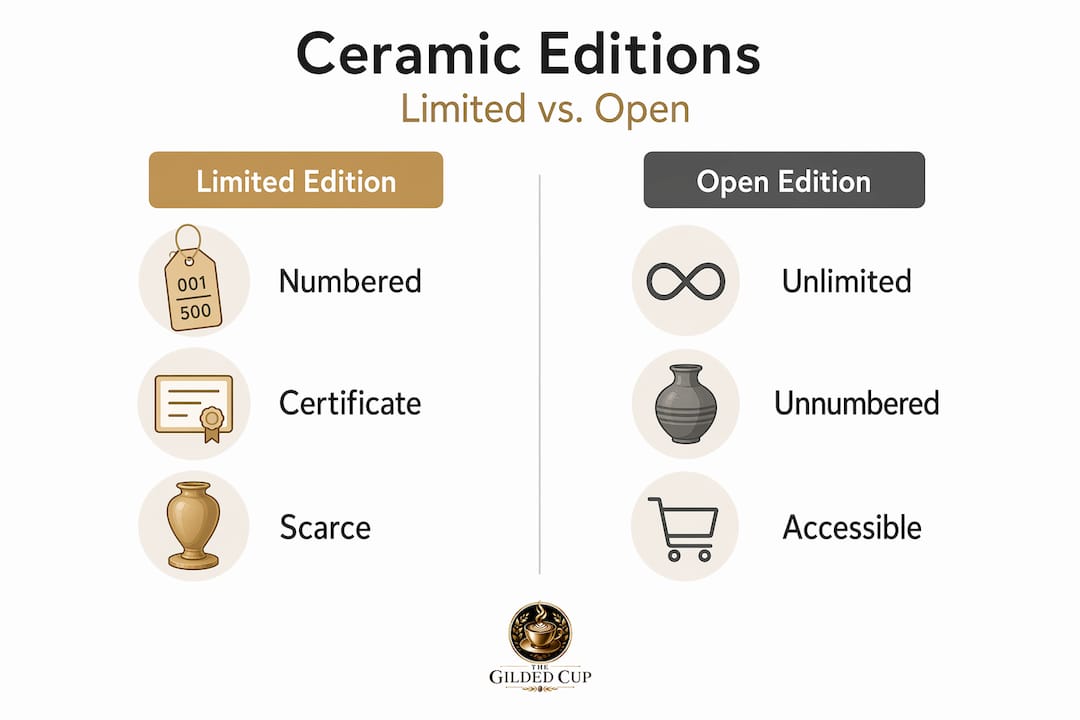
Here is a direct comparison to keep in mind when evaluating any piece:
| Criteria | Limited edition | Open edition |
|---|---|---|
| Production run | Fixed, verifiable | Unlimited |
| Numbering | Present | Absent |
| Price premium | Justified by scarcity | Based on design only |
| Resale potential | Higher | Lower |
| Investment grade | Possible | Unlikely |
When buying limited edition ceramics, run through this checklist before committing:
- Confirm the edition size in writing: Not “limited quantities available” but an actual number, such as 40 pieces total
- Request or verify the certificate: A legitimate edition will have documentation you can photograph and file
- Research the artist or brand: A first-time studio with no track record is a higher risk than an established ceramicist with a documented history of closed editions
- Check secondary market activity: If previous editions from the same maker have sold at or above retail, that is a meaningful signal
- Inspect the numbering: Hand-stamped or hand-written numbers are a positive sign. Printed stickers are not
Pro Tip: Search auction records for the artist’s name before purchasing. Even one or two secondary market sales for prior editions tells you that real demand exists beyond the original retail context. A white glossy mug from a documented series with auction history is a fundamentally different asset than one without it. The same logic applies to any black glossy mug or serving piece you are considering.
How to evaluate and collect limited edition ceramics effectively
Collecting fine ceramics well is a skill built over time, but a clear evaluation framework shortens the learning curve considerably.
Follow these steps when assessing any piece:
- Verify the production cap first. Numeric caps and clear edition structure are materially stronger evidence than marketing language alone. Ask for the number. If the seller cannot provide it, treat the piece as an open edition.
- Assess provenance carefully. Who made it, when, and under what conditions? Studio potters with exhibition records carry more weight than anonymous “artisan” branding.
- Examine the firing method. Wood-fired, salt-fired, and high-temperature reduction pieces carry inherent uniqueness that adds to their value beyond the edition number alone.
- Understand current market demand. A limited edition of 200 pieces from a ceramicist no one is collecting is not scarce in any meaningful sense. Edition size only matters relative to demand.
- Store and maintain condition. Even the most valuable ceramics lose market appeal with chips, crazing from improper storage, or glaze damage. Store pieces away from direct sunlight and temperature extremes, and handle them with clean, dry hands.
An enamel mug with a documented firing history and clear edition structure, stored properly from day one, will hold its condition and its story far better than a piece treated carelessly.
Pro Tip: Build a simple collection log. Record the edition number, purchase date, seller, price, and any documentation received for every piece you acquire. This record becomes part of the provenance chain and adds real value if you ever sell or insure the collection.
Rethinking rarity and value in limited edition ceramics
Here is the perspective most collectors miss: the number on the bottom of a piece is not the most interesting thing about it.
Collectors, especially those new to the field, fixate on edition size. A run of 20 feels more valuable than a run of 200. That logic holds, but only up to a point. What it misses is the intrinsic rarity that comes from the firing process itself. Variability from traditional firing methods creates unique aesthetics, making each piece’s form of rarity more than just edition numbers.
Consider what this means in practice. Two pieces numbered 14/50 and 22/50 from the same edition are technically identical in their edition status. But if they were fired in a wood kiln, their surface colors, the way the ash settled, the depth of the glaze pooling — all of that will differ. You are not holding one of 50 identical objects. You are holding one object that happens to share its edition with 49 others that each look slightly different.
This is the argument for valuing craft history and process alongside the editioning structure. A white glossy mug from a studio with a 300-year firing tradition carries a different weight than a numbered piece from a brand that outsourced production and applied a certificate afterward.
The collectors who build the most interesting and durable collections are the ones who ask about the kiln, the glaze chemistry, and the maker’s lineage, not just the edition size. Numbered scarcity is a starting point. Craft-based uniqueness is where the real story lives.
Explore limited edition and collectible ceramics at The Gilded Cup
If this guide has sharpened your eye for what genuine limited edition ceramics look like, the next step is finding pieces that meet that standard.
At The Gilded Cup, every piece in our ceramics selection is chosen with provenance, craftsmanship, and edition integrity in mind. Whether you are drawn to the clean lines of a white glossy mug from a documented studio run, the depth of a black glossy mug finished with a reactive glaze, or the tactile character of an enamel mug built for daily use and long-term collecting, our catalog reflects the same criteria this guide outlines. Explore the collection and find pieces worth owning for the right reasons.
Frequently asked questions
What makes limited edition ceramics more valuable than open editions?
Limited editions are produced with a finite quantity, often with numbering or certification, while open editions can be restocked indefinitely, which means limited editions carry verified scarcity that directly supports their collectible and resale value.
How does manufacturing affect the scarcity of limited edition ceramics?
High scrap rates in firing can cap production at as few as 100 acceptable pieces per year, meaning the edition limit is often set by what the kiln actually produces rather than by a marketing decision.
Are limited edition ceramics always just for display?
No. Limited editions are often marketed as collectible functional objects like tableware intended for years of actual use, so the best pieces are designed to be both lived with and collected.
How can I verify if a limited edition ceramic piece is truly limited?
Look for a specific edition number, a certificate of authenticity with a named production cap, and verifiable provenance from a reputable artist or brand. Numeric caps and clear edition structure are stronger evidence than any marketing claim.
Does the unpredictable firing process affect the value of ceramics?
Yes. Thermal shock firing produces unpredictable, unique colors and textures that make large-scale repetition difficult, adding intrinsic rarity to each piece beyond what the edition number alone conveys.