

What Is Glassware Provenance: a Collector's Guide
Most collectors assume provenance simply means knowing where a piece was purchased. It doesn’t. What is glassware provenance, properly understood, is the complete documented history of an object: who owned it, where it originated, how it moved through time, and what physical evidence supports those claims. This distinction matters enormously whether you’re acquiring a Georgian rummer, a Lalique art glass vase, or a mid-century Murano bowl. Provenance is the difference between a beautiful object and a historically significant one, and understanding it will permanently change how you evaluate and collect fine glass.
Table of Contents
- Key takeaways
- What glassware provenance really means
- Scientific methods for identifying glassware origin
- Provenance in authentication and glassware valuation
- Practical steps for researching glassware provenance
- My honest take on provenance research
- Explore fine glassware with Thegildedcup
- FAQ
Key takeaways
| Point | Details |
|---|---|
| Provenance is full history | It covers ownership, geographic origin, and findspot context, not just the last point of sale. |
| Science fills documentation gaps | Compositional analysis techniques can identify glassware origin when paperwork is absent or incomplete. |
| Documentation types vary widely | Bills of sale, auction records, labels, photographs, and inscriptions all count as provenance evidence. |
| Mismatches reveal fakes | When documentary records contradict material analysis, authenticity concerns arise immediately. |
| Partial provenance still has value | Treat incomplete records as cumulative evidence rather than demanding absolute proof. |
What glassware provenance really means
The formal term you’ll encounter in museum and cultural heritage contexts is provenience when referring specifically to an object’s findspot, and provenance when referring to its full ownership history. In everyday collector use, the two terms often merge, but the distinction matters. UK government guidance defines provenance as the complete history and ownership of an object from its discovery or creation to the present day. For archaeological glass, the findspot is often the most critical data point because context tells you about the culture, trade network, and period of manufacture.
For collectors of antique or vintage glassware, provenance typically covers several layers:
- Creation origin: The factory, workshop, or region where the glass was made, along with the period and technique
- Ownership trail: Every recorded change of hands, from the original owner through auctions, dealers, estates, and private sales
- Physical documentation: Bills of sale, auction house catalog entries, insurance appraisals, estate inventories, dealer labels, and correspondence
- Contextual records: Exhibition loans, museum loans, period photographs, and scholarly publications that mention the piece
Common sources of provenance information include auction house archives, estate sale records, dealer stock books, and published catalogs. Museums and research institutions often hold correspondence and acquisition records that are accessible to researchers. The North Carolina Museum of Art describes provenance research as interdisciplinary detective work, drawing on art history, archival science, and sometimes forensic analysis, with the explicit acknowledgment that complete provenance is rarely available for older objects.
Pro Tip: When evaluating a piece, always ask the seller specifically about documentation, not just where they acquired it. The documentation chain behind their acquisition matters as much as the piece itself.
Scientific methods for identifying glassware origin
Documentary provenance has a ceiling. Records get lost, dealers fold, and estates get dispersed without proper cataloging. This is where materials science has fundamentally shifted how provenance works for serious collectors and scholars.
A 2025 study published in npj Heritage Science demonstrated that non-destructive analytical techniques can identify both the origin and manufacturing methods of ancient glassware with high confidence, even when no documentary record exists. The study analyzed ancient Chinese glassware from the Jiujian Site using four complementary methods:
- Laser Raman spectroscopy: Identifies mineral inclusions and colorants, revealing which raw materials were used and pointing to specific geographic deposits
- X-ray diffraction (XRD): Reveals the crystalline structure of devitrified glass and inclusions, linking samples to known regional production traditions
- Particle-induced X-ray emission (PIXE): Measures trace element concentrations that act as chemical fingerprints for specific raw material sources
- Scanning electron microscopy with energy-dispersive spectroscopy (SEM-EDS): Examines surface and cross-sectional microstructure to identify manufacturing techniques and repairs
These techniques are non-destructive, meaning the object is not damaged in the analysis process. The chemical signature of glass reflects the raw materials used to produce it, and different regions had access to fundamentally different silica sources, fluxing agents, and colorants.
| Technique | What it reveals | Provenance application |
|---|---|---|
| Raman spectroscopy | Colorants, inclusions | Links pigments to geographic mineral sources |
| XRD | Crystalline structure | Matches production region and period |
| PIXE | Trace element profile | Chemical fingerprint of raw material origin |
| SEM-EDS | Microstructure, repairs | Identifies manufacturing tradition and later alterations |
The practical implication for collectors is significant. When documentation is missing, the glass itself can provide proxy evidence supporting or contradicting claimed origins. A piece attributed to Bohemian glassworks with a chemical profile pointing to English lead crystal production is a problem. The material tells the truth even when paperwork doesn’t.
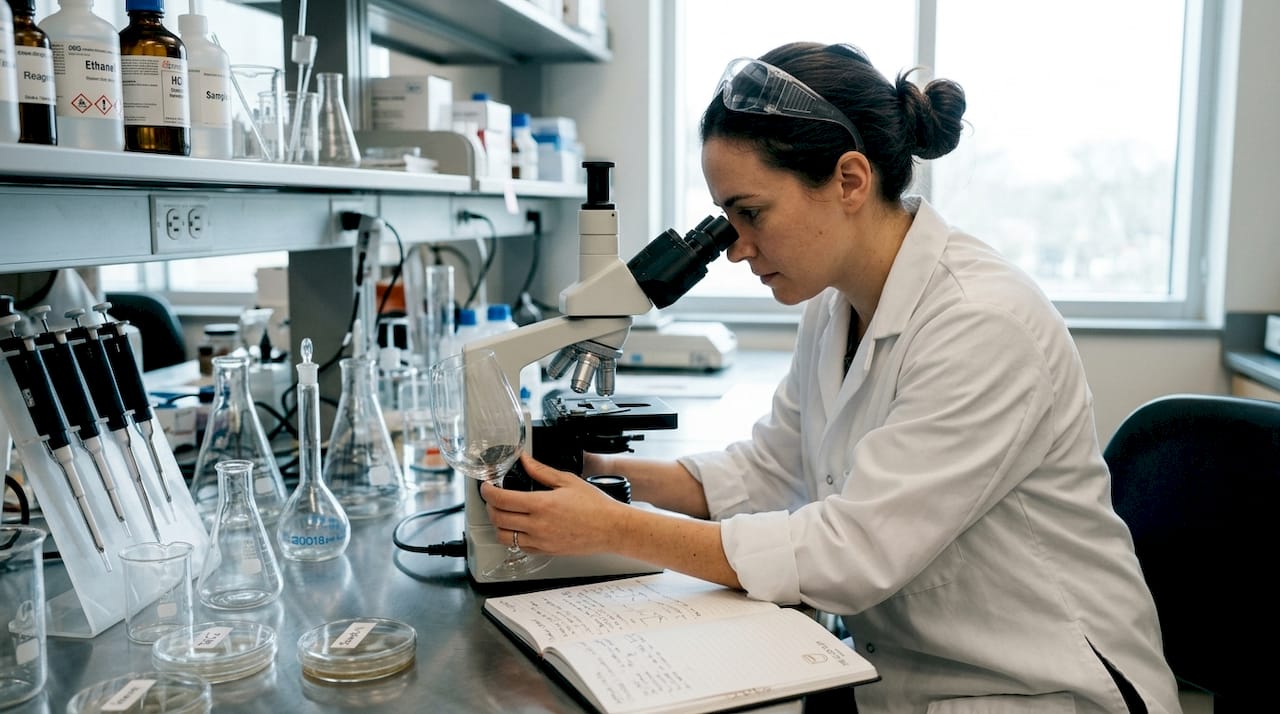
Pro Tip: If you’re considering a significant purchase and provenance documentation is thin, look for auction houses or specialist appraisers who work with institutions offering compositional analysis services. The cost is often modest compared to the purchase price.
Provenance in authentication and glassware valuation
For collectors and the market, provenance functions as both an authentication tool and a value multiplier. Understanding what affects glassware value requires separating the two roles clearly.
Authentication is the primary function. Collectors and specialists evaluate provenance as two parallel tracks: the ownership trail and the material origin. When these two tracks align, confidence in authenticity rises sharply. When they contradict each other, that mismatch is often the first signal of a forgery or misattribution. A label claiming a piece is a 19th-century Baccarat crystal champagne flute means very little if the glass composition lacks the lead oxide profile characteristic of that period and manufacturer.
The types of documentation that carry weight in the market include:
- Primary records: Original bills of sale, auction house invoices, and dealer receipts with dates and descriptions
- Exhibition and publication history: Inclusion in scholarly catalogs, museum loans, or period magazine features adds significant credibility
- Physical markers: Factory labels (paper or foil), acid-etched marks, pontil signatures, and inscribed dedications that match the claimed period and maker
- Photographic evidence: Period photographs showing the piece in a documented setting, estate photographs, or historical images from published sources
Incomplete provenance is not the same as no provenance. Even partial records carry evidential weight when they are consistent with the object’s physical characteristics and manufacturing context. A piece with a dealer label from a known specialist gallery operating in 1910 and compositional data consistent with that period has meaningful provenance, even if the earlier ownership history is unknown.
For pieces related to vintage glassware identification, understanding what documentary and material evidence typically exists for a given period and manufacturer is the baseline skill you need before evaluating any specific claim.
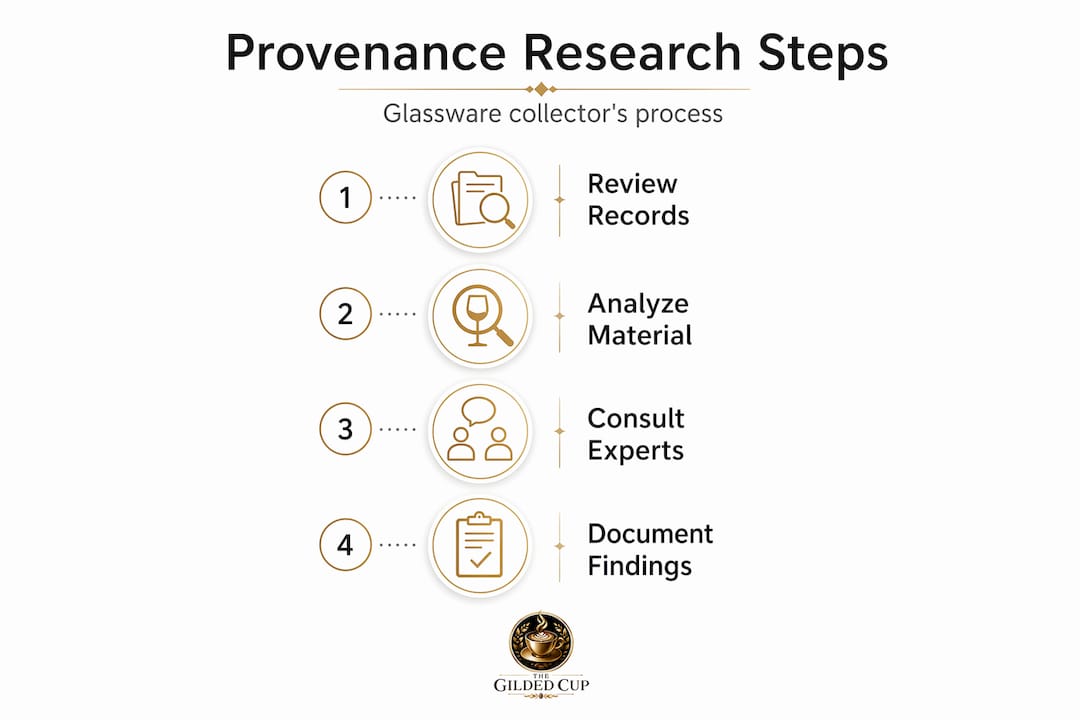
Practical steps for researching glassware provenance
Research always starts with the object. Before you open an archive or contact a specialist, spend time with the piece itself. The glass carries information in its marks, labels, construction details, and physical condition that will either corroborate or contradict any documentation you find.
- Examine and photograph every mark. Pontil marks, mold seams, acid-etched signatures, paper labels, and foil stickers all narrow the field of possible origins and periods. Photograph these in raking light to capture subtle features.
- Cross-reference physical traits with production history. The weight of the glass, the presence or absence of lead, the color quality, the cutting style, and the forming technique each correspond to specific periods and regions. Matching physical production traits with historical documentation is the core methodology of credible provenance research.
- Search auction archives. Christie’s, Sotheby’s, Bonhams, and specialist decorative arts auction houses maintain searchable archives of past sales. A lot description from a 1972 auction can establish ownership at that point and often includes prior collection history.
- Consult specialist dealers and museum curators. Dealers who specialize in a particular period or manufacturer often know the ownership histories of significant pieces. Museum curators are frequently willing to assist serious researchers.
- Digitize and organize everything you find. Create a provenance file for each significant piece. Scan documents, photograph labels in situ before removal, and record oral history from sellers in writing at the time of purchase.
- Handle gaps responsibly. Provenance records are frequently incomplete, and treating a partial record as absolute proof is a serious error. Record what you know, note what is unverified, and be transparent about gaps when selling or lending a piece.
Understanding glassware patina is closely connected to this process. Authentic age-related surface changes on glass can corroborate a claimed period of manufacture, while their absence on supposedly old glass is a meaningful red flag worth investigating further.
My honest take on provenance research
I’ve spent years working with fine glass, and the single most common mistake I see collectors make is treating provenance as binary: either a piece has it or it doesn’t. That framing misses everything interesting about the field.
In my experience, provenance research is inherently probabilistic. You are building a case, not finding a fact. The documentation might get you to 1950 with confidence, the physical traits might take you back to the 1880s with reasonable certainty, and the gap in between is a judgment call based on the weight of consistent evidence. That’s not a failure of the research process. That’s the process working correctly.
What I find collectors resist is the idea that the glass itself is evidence. People want paper. But a piece with a chemical profile perfectly consistent with its claimed Murano origin, construction marks that match the period, and genuine surface weathering is telling you something real. Combining scientific analysis with documentary evidence gives you a far more reliable picture than either alone.
The emotional and cultural value provenance adds is not separate from its monetary impact. A Georgian rummer with a documented connection to a specific estate or historical figure is worth more than an identical piece with no history. But more than price, that documented connection makes the object meaningful in a way that transcends the glass itself. That’s why this work is worth doing carefully.
— Sharbel
Explore fine glassware with Thegildedcup
Understanding provenance transforms how you look at every piece of glass you acquire. At Thegildedcup, that same depth of attention to origin, craftsmanship, and documented quality shapes every product in our collection.
Our curated glassware collaborations bring together artisans and makers whose work carries real craft history, not just aesthetic appeal. Each collaboration is selected with an emphasis on transparency about materials, manufacturing tradition, and the makers behind the pieces. Whether you are building a serious collection or looking for fine drinkware that carries genuine meaning, Thegildedcup offers pieces worth knowing the story behind. Explore the collection and find glassware that rewards the kind of careful attention provenance research teaches you to bring.
FAQ
What does glassware provenance mean?
Glassware provenance is the documented history of a piece from its creation or discovery to the present, covering ownership changes, geographic origin, and any physical or archival evidence supporting those claims. It goes well beyond knowing where a piece was last purchased.
How does provenance affect glassware value?
Provenance strengthens authentication and raises market value by providing verifiable evidence of origin, ownership, and historical significance. Even partial documentation that aligns with a piece’s physical characteristics adds credibility and collector confidence.
Can I determine provenance without paperwork?
Yes. Compositional analysis techniques such as Raman spectroscopy and PIXE can identify the geographic and technological origin of glass even when documentary records are absent, providing material evidence that supports or contradicts claimed provenance.
What is the difference between provenance and provenience?
Provenance refers to the full ownership and custody history of an object, while provenience specifically refers to the findspot or archaeological context of discovery. In everyday collector use the terms often overlap, but the distinction matters for antiquities.
Where do I start researching a piece’s ownership history?
Start with the object itself. Examine marks, labels, construction details, and surface condition, then cross-reference those physical traits with archives from auction houses, dealers, and museum records to build a documented ownership trail.