

What Is Cut Crystal? A Collector's Complete Guide
Cut crystal is a type of glass that contains at least 30% lead oxide and is shaped through precision hand-cutting to maximize light refraction and brilliance. The lead content makes it heavier, softer, and more workable than ordinary glass. Those properties allow artisans to carve deep, intricate facets that ordinary glass simply cannot hold. If you collect fine glassware or shop for luxury gifts, understanding what is cut crystal separates a meaningful purchase from an expensive mistake.
What is cut crystal and how does it differ from regular glass?
Cut crystal is defined by two things: its chemical composition and its cutting method. Lead content in luxury crystal often exceeds 30% to maximize refraction and weight. That lead oxide is what gives crystal its signature heft and its ability to bend light into rainbow prisms. Regular glass contains no lead and produces none of that optical drama.
The term “crystal” is also widely misunderstood. Collectors often mistake “crystal” for a mineral, but it actually refers to leaded glass with augmented optical and physical properties. The word signals a manufacturing standard, not a geological material. Knowing that distinction prevents the most common buying error in the collectible glassware market.
Crystal is more transparent than glass, with high refraction that gives it extra glitter, and it typically features thinner walls with delicate rims. Those thinner walls are possible because lead oxide strengthens the material. Crystal is heavier than ordinary glass because of added metals, yet it can be made thinner and more delicate without risk of breakage.
How is cut crystal made?
The production of authentic cut crystal follows a sequence of skilled steps that mass manufacturing cannot replicate.
The raw material stage begins with a molten glass batch where lead oxide is introduced during melting. The lead makes the glass denser and more responsive to cutting tools. Without it, the glass would chip rather than carve cleanly.
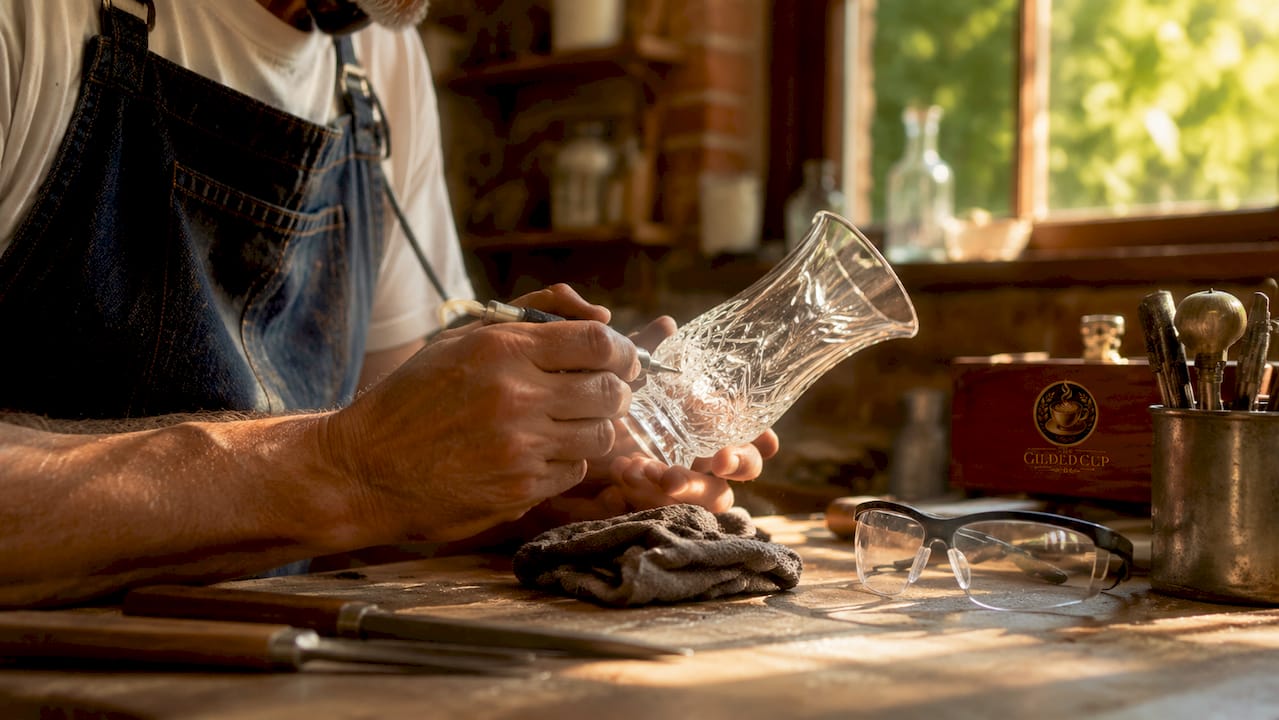
The cutting stage is where the artisan’s skill becomes visible. Hand-cutting involves marking designs and grinding with diamond or carborundum wheels. Each facet is planned as a geometric surface designed to interrupt and redirect light. Experienced artisans perform cutting freehand on rotating abrasive wheels, making micro-adjustments that machines cannot replicate. That freehand control is what gives each piece its optical character.
The smoothing and polishing stage separates high-quality pieces from budget alternatives. True hand-cut crystal involves an initial rough cut followed by a smoothing stage, adding time and skill rarely seen in mass production. The polishing process for high-quality cut crystal uses hot acid baths to achieve clarity and brilliance, compared to mechanical buffing used in cheaper alternatives. Acid polishing dissolves microscopic surface ridges, producing the glass-clear finish collectors recognize immediately.
- Molten glass is mixed with lead oxide before shaping
- Designs are marked on the blank piece before cutting begins
- Diamond or carborundum wheels grind each facet into shape
- A smoothing pass removes rough edges left by the initial cut
- Acid polishing or mechanical buffing brings the final clarity
Pro Tip: Run your fingertip across the cut edges of a piece. Authentic hand-cut crystal has rounded, smooth edges. Machine-pressed glass leaves sharper, more uniform ridges that feel almost knife-like.
Cut crystal vs glass vs pressed glass: how do you tell them apart?
The differences between cut crystal, ordinary glass, and pressed glass show up in weight, touch, sound, and light behavior.
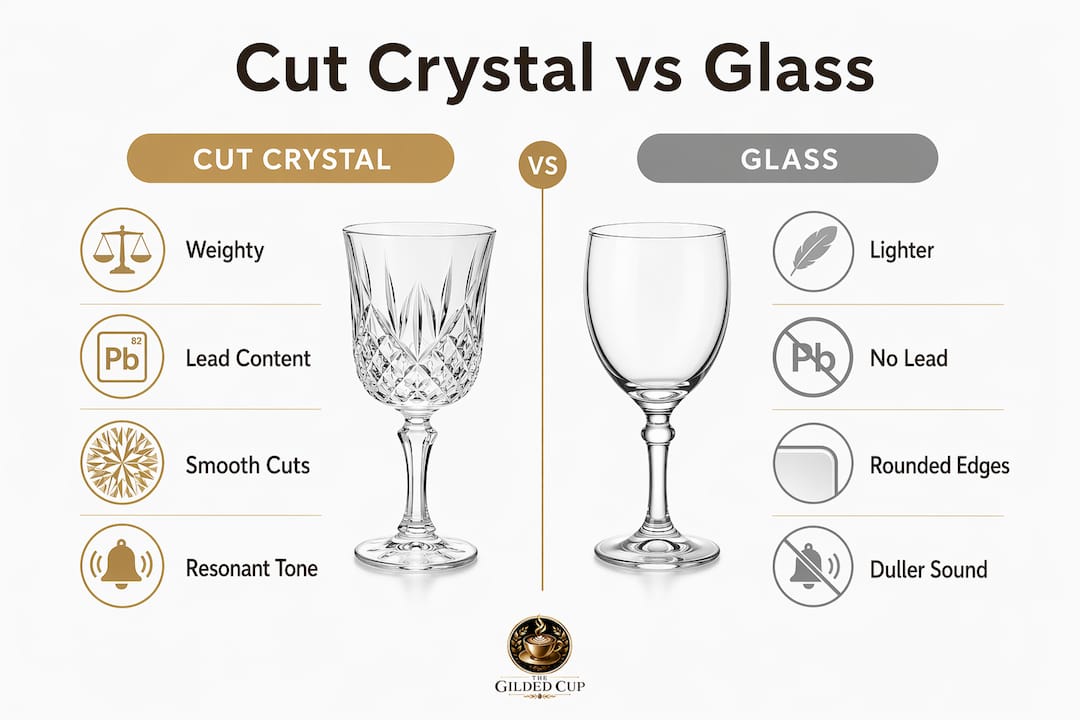
| Property | Cut crystal | Ordinary glass | Pressed glass |
|---|---|---|---|
| Weight | Heavier due to lead oxide | Lighter | Heavier but less refined |
| Edge feel | Rounded, smooth cuts | Sharp or flat | Sharp, uniform ridges |
| Light behavior | Rainbow prism, high refraction | Minimal refraction | Low refraction |
| Sound when tapped | Clear, resonant chime | Dull thud | Dull thud |
| Transparency | High, almost water-clear | Moderate | Moderate to low |
Crystal produces a distinct, resonant chime and a rainbow prism under light, while pressed glass has sharper edges and a different tactile feel. That chime test is the fastest field check a collector can perform. Hold the piece at the rim and tap it gently with a fingernail. Crystal rings. Glass thuds.
Pressed glass is made by forcing molten glass into a mold under pressure. The result looks similar to cut crystal from a distance but fails every close inspection. The cuts are sharp, the edges are uniform, and the light behavior is flat. Pressed glass is also usually heavier than cut crystal of the same size because it lacks the refined thinning that lead oxide allows.
Here is a practical three-step identification method:
- Tap test. Tap the rim with a fingernail. A clear, sustained ring indicates crystal. A short, dull sound indicates glass.
- Light test. Hold the piece up to a light source. Cut crystal throws rainbow prisms. Pressed glass produces little to no color separation.
- Edge test. Run a finger across the cut lines. Rounded, smooth edges confirm hand-cutting. Sharp, mold-consistent ridges indicate pressing.
Pro Tip: Examine a piece under a magnifying glass. Most modern cut crystal skips the smoothing stage, leaving microscopic ridges visible under magnification. True artisan pieces show clean, polished facets with no visible tool marks.
What is the history of cut crystal and why does it matter?
Cut crystal’s origins trace directly to one inventor and one discovery. George Ravenscroft added lead oxide to glass in the 17th century, making it heavier, softer, and suitable for intricate engraving. That single innovation created the foundation for every piece of luxury crystal produced since. Before Ravenscroft, European glassmakers worked with soda-lime glass that chipped under deep cutting tools.
The craft expanded through the 18th and 19th centuries as Irish, Bohemian, and English glasshouses competed to produce the most elaborate patterns. Waterford in Ireland and Bohemian workshops in what is now the Czech Republic became the dominant names in the trade. Their cut crystal designs, featuring deep mitre cuts, hobstar patterns, and fan motifs, set the visual language that collectors still recognize today.
“Cut crystal facets are deliberate optical instruments, crafted to manipulate light for brilliance rather than mere decoration.” — Bohemian Crystal: Crafting Light Through Precision
Cut crystal became a standard luxury gift in the 19th century. Decanters, vases, and stemware appeared on the tables of wealthy households across Europe and America. That cultural role as a prestige object is why antique cut crystal pieces hold strong value in today’s collectible market. The craftsmanship is irreproducible at scale, which keeps supply limited and demand steady among serious collectors.
The artisan techniques for hand-cut crystal that Ravenscroft’s innovation made possible remain the benchmark for quality. Heritage Crafts in the UK has documented cut crystal glass making as a skilled trade worth preserving. That recognition reflects how rare genuine hand-cutting expertise has become.
What are the benefits of cut crystal for home decor and gifts?
Cut crystal delivers advantages that no machine-made alternative can match. Artisans design each cut as a geometric surface to interrupt and bend light, maximizing internal reflections for brilliance. That optical performance transforms a simple vase or decanter into a light source in its own right. Place a cut crystal piece near a window and it casts moving color patterns across the room throughout the day.
For home decor, cut crystal works as both functional object and display piece. A crystal decanter on a bar cart reads as a collector’s item. A crystal vase on a dining table catches candlelight in a way that ceramic or pressed glass never does. The weight and clarity signal quality to anyone who picks the piece up.
For gift-giving, the added weight and sparkle of crystal justify higher investment and appeal in luxury and collectible markets compared to machine-made glassware. A hand-cut crystal whiskey glass or champagne flute communicates a level of care that a standard gift cannot. The piece is also durable. Lead crystal, properly cared for, lasts generations.
Care recommendations for cut crystal:
- Hand wash only. Dishwashers cause thermal stress and cloudiness.
- Use warm water with a small amount of mild dish soap.
- Avoid abrasive cloths. Use a soft microfiber towel to dry.
- Store upright, not inverted, to protect the rim.
- Preserve brilliance long-term by rinsing immediately after use to prevent staining.
Pro Tip: When sourcing cut crystal, ask specifically whether a piece is hand-cut or machine-pressed. Retailers who specialize in luxury glassware will always know the answer. If they cannot confirm, treat the piece as pressed glass until proven otherwise.
Key takeaways
Cut crystal is defined by its lead oxide content and hand-cut facets, and those two factors determine every quality, value, and care decision a collector makes.
| Point | Details |
|---|---|
| Lead oxide is the defining ingredient | Crystal must contain over 30% lead oxide to achieve its weight, workability, and refraction. |
| Hand-cutting creates optical performance | Artisans grind each facet freehand to bend light, producing brilliance no mold can replicate. |
| Three tests identify authentic crystal | The tap test, light test, and edge test together confirm whether a piece is crystal or pressed glass. |
| George Ravenscroft started it all | His 17th-century lead oxide formula gave rise to the deep-cut designs that define luxury glassware today. |
| Care determines longevity | Hand washing and proper storage protect the clarity and rim integrity of cut crystal for generations. |
Why I think most collectors underestimate what they’re holding
Sharbel here. After years of handling fine glassware, the thing that still surprises me is how few collectors actually understand the optical engineering behind a well-cut piece. Most people see sparkle and think decoration. What they are actually looking at is a series of calculated angles, each one placed to redirect light through the body of the glass and back out toward the viewer. That is not craft for craft’s sake. That is physics applied by hand.
The misconception I see most often is that “crystal” means expensive glass. It does not. It means a specific material with specific properties, shaped by a specific process. A pressed glass piece can cost as much as a hand-cut crystal piece if the branding is right. The price tag tells you nothing. The tap test, the edge feel, and the light behavior tell you everything.
My honest advice to any collector: buy the piece that makes you stop. Cut crystal has a way of holding attention that pressed glass never does. You pick it up, you feel the weight, you hear the ring, and you understand immediately why this material has been prized for three centuries. That reaction is not nostalgia. It is the correct response to genuine craftsmanship.
One more thing worth saying: do not overlook contemporary artisan pieces in favor of antiques. Modern hand-cut crystal from skilled workshops can be as optically impressive as anything produced in the 19th century. The affluent collector’s guide to bar glasses at Thegildedcup makes that case well. Age is not the only measure of quality in this category.
— Sharbel
Authentic cut crystal at Thegildedcup
Thegildedcup curates a selection of hand-cut crystal and artisan glassware chosen for optical quality, craftsmanship, and lasting value. Every piece in the collection is sourced with the collector and the gift-giver in mind.

Whether you are furnishing a home bar, selecting a meaningful gift, or adding to a serious collection, Thegildedcup offers detailed product descriptions and expert guidance to help you choose with confidence. The team understands the difference between hand-cut and machine-pressed, and that knowledge is reflected in every piece they carry. Visit Thegildedcup to browse the full collection of luxury glassware and fine drinkware.
FAQ
What is cut crystal made of?
Cut crystal is made from glass that contains at least 30% lead oxide, which gives it extra weight, clarity, and the ability to refract light into rainbow prisms. The lead content also makes the glass soft enough for artisans to carve precise facets by hand.
How do I know if a piece is real cut crystal?
Tap the rim with a fingernail. Authentic cut crystal produces a clear, sustained ring. Also check the edges of the cut patterns: hand-cut crystal has rounded, smooth edges, while pressed glass leaves sharp, uniform ridges.
What is lead crystal and is it the same as cut crystal?
Lead crystal refers to glass with added lead oxide, which is the base material for cut crystal. Cut crystal is lead crystal that has been shaped with hand-cut facets. All cut crystal is lead crystal, but not all lead crystal is cut.
Is cut crystal safe to use for drinking?
Modern cut crystal produced for drinkware is generally considered safe for regular use. Antique lead crystal decanters carry a higher risk of lead leaching, particularly when used to store acidic beverages like wine or spirits for extended periods.
How should I care for cut crystal?
Hand wash cut crystal in warm water with mild soap and dry it immediately with a soft microfiber cloth. Avoid dishwashers, abrasive scrubbers, and prolonged soaking, all of which can cloud the surface and weaken the rim over time.