

What Is Artisan Drinkware: Craftsmanship and Value
Artisan drinkware is exactly what its name suggests: drinkware made by hand, with skill, intention, and a deep respect for material. But that definition barely scratches the surface of what is artisan drinkware in its fullest form. Mass-produced glassware gets the job done. Artisan drinkware does something else entirely. It carries the mark of a specific maker, the weight of a centuries-old tradition, and a physical presence that factory output simply cannot replicate. Whether you’re considering your first handcrafted mug or building a serious collection, understanding what separates artisan pieces from the rest is the foundation for making purchases you’ll never regret.
Table of Contents
- Key takeaways
- The roots of artisan drinkware craftsmanship
- Materials and sustainability in artisan production
- The sensory experience of artisan drinkware
- How to identify authentic artisan drinkware
- My perspective on what artisan drinkware really means
- Explore artisan drinkware at Thegildedcup
- FAQ
Key takeaways
| Point | Details |
|---|---|
| Handcrafted by definition | Artisan drinkware is made by skilled craftspeople using manual techniques, not automated production lines. |
| Materials matter significantly | Natural materials like Urushi lacquer and recycled glass define artisan quality and longevity. |
| Imperfections signal authenticity | Slight variations in shape, color, or texture confirm a piece was shaped by human hands. |
| Sustainability is built in | Many artisan producers use recycled materials and renewable energy, making your purchase environmentally responsible. |
| Value appreciates over time | Artisan pieces tied to specific makers or traditions carry cultural and collectible significance beyond their function. |
The roots of artisan drinkware craftsmanship
The story of artisan drinkware is not a recent trend. It is a continuation of human practice stretching back thousands of years. Glassblowing, for instance, emerged around 50 BCE in the Syro-Palestinian region and spread rapidly across the Roman Empire precisely because it allowed craftspeople to create vessels of remarkable beauty and utility. Lacquerware has an even older history, with techniques documented across East Asia for over 7,000 years that remain largely unchanged today.
What makes these traditions extraordinary is the sheer investment of time and labor they demand. Producing a single piece of lacquerware, for example, can take three to six months and involves up to 30 distinct layers of application, curing, and sanding. Each layer must fully cure under controlled humidity before the next is applied. There are no shortcuts. The process is either done correctly or the piece fails.
What is artisanal craftsmanship at its core? It is the decision to prioritize the integrity of the object over the speed of its production. Consider the methods involved in traditional artisan glassware:
- Glassblowing: A gather of molten glass is shaped entirely through the breath and tools of a single glassblower, producing organic curves and subtle asymmetries no machine can reproduce.
- Layered lacquering: The sanding and polishing of lacquer layers creates visual depth achievable only through manual repetition, not industrial processes.
- Hand-thrown ceramics: What is artisanal ceramics? It is clay centered on a wheel by human hands, shaped through pressure and feel, producing pieces with a physical personality unique to that session and that maker.
- Inlay and gilding: Gold leaf, mother-of-pearl, and enamel are applied by hand in precise patterns, often requiring years of training to execute with consistency.
Pro Tip: When examining a piece described as artisan, run your thumb along its base or interior. The slight variations in thickness and texture you feel there are exactly what you are paying for.
Heritage craftsmanship has persisted not because it is commercially efficient, but because it produces objects that outlast industrial alternatives by generations. That persistence is its own form of proof.
Materials and sustainability in artisan production
The choice of material is where artisan drinkware most clearly separates itself from mass-market alternatives. Factory production favors synthetic coatings, uniformly sourced soda-lime glass, and petroleum-based glazes because they are cheap and consistent. Artisan production favors materials with history, behavior, and ecological honesty.

Natural lacquer, known as Urushi, is one of the most striking examples. It is a living organic polymer tapped from the Toxicodendron vernicifluum tree. Urushi cures through oxidation in high humidity rather than through heat, producing a finish that strengthens over decades rather than degrading. No synthetic coating replicates this property.
Recycled glass is another defining material in responsible artisan production. The studio Xaquixe, based in Oaxaca, Mexico, uses 97% recycled glass combined with proprietary glass formulas and heat-recovery furnaces that significantly reduce energy consumption. Their process demonstrates something important: artisan methods and environmental responsibility are not in tension. They are naturally aligned.
“Sustainable artisan enterprises empower communities and support environmentally responsible production, using recycled materials and renewable energy to benefit rural livelihoods.”
The contrast with conventional drinkware manufacturing is stark. Most factory-made glassware relies on virgin raw materials, fossil fuel-intensive furnaces, and chemical glazes that do not biodegrade cleanly. When you ask why invest in artisanal glassware, this is one of the most concrete answers: your purchase actively supports production systems designed to leave less behind.
What is artisan glazing in this context? It refers to hand-applied mineral and oxide-based coatings that interact uniquely with kiln heat, producing color variations and surface textures that are part of the piece’s character rather than defects to be corrected. No two glazed pieces from the same kiln firing are identical.
The sensory experience of artisan drinkware
Function is table stakes. Any cup holds liquid. What artisan drinkware provides is a sensory experience that changes how you relate to the act of drinking itself.
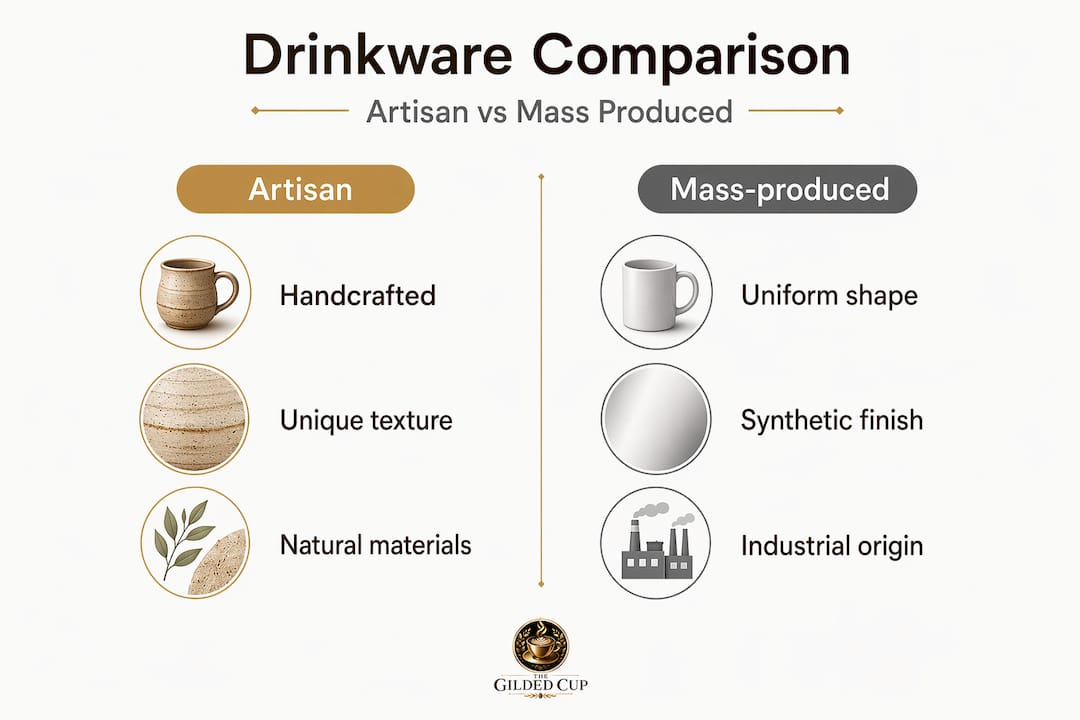
Start with weight and balance. Handcrafted pieces are shaped with intention around how they feel in the hand. A well-made lacquerware cup described as “skin-like” in texture creates what makers describe as a meditative connection between drinker and drink. That is not marketing language. It is a material property: lacquer’s natural thermal insulation means you can hold a cup of hot tea comfortably without a handle, creating a fundamentally different physical relationship with your beverage.
Pro Tip: If you are comparing artisan ceramics to standard ceramic mugs, fill both with hot water and hold each for thirty seconds. The artisan piece will almost always feel more comfortable to hold for longer, because wall thickness is varied intentionally rather than standardized.
| Feature | Artisan drinkware | Mass-produced drinkware |
|---|---|---|
| Surface texture | Hand-finished, varies by piece | Machine-smooth, uniform |
| Thermal feel | Naturally insulating | Conducts heat uniformly |
| Visual depth | Layered, luminous finishes | Flat, printed decoration |
| Weight distribution | Shaped for hand comfort | Standardized for stackability |
| Emotional response | Personal, connected | Neutral, functional |
The visual qualities of artisan pieces are equally significant. What is artisanal glass when held up to light? It is depth. Layers of color, trapped bubbles from the blowing process, and subtle variations in wall thickness catch and scatter light in ways that flat-pressed glass simply does not. What is artisanal glassware beyond its material composition? It is an object with a visual life that changes depending on the light and angle.
For a deeper look at how these qualities translate into specific collectible formats, the guide on tumbler glass collecting at Thegildedcup is worth reading alongside this overview.
How to identify authentic artisan drinkware
The market for artisan drinkware includes a significant number of pieces that are artisan-inspired rather than genuinely handcrafted. Knowing how to distinguish them protects both your investment and your trust in the category.
Handmade glassware is slightly irregular and one-of-a-kind, carrying the marks of the tools and hands that shaped it. Here is what to look for:
- Maker’s marks or signatures: Authentic artisan pieces often carry a signature, studio mark, or certificate of provenance. Mass-produced “artisan-style” pieces do not.
- Visible tool marks: Small ridges, pontil marks on the base of glassware, or slight rim irregularities confirm hand finishing. These are features, not flaws.
- Color variation within a single piece: In hand-glazed ceramics or blown glass, color shifts naturally across the surface. Machine-applied finishes are perfectly uniform.
- Weight asymmetry: Hold the piece at different points around its circumference. A slight variation in balance indicates hand-shaping rather than mold casting.
- Material provenance: Reputable artisan producers document their materials. Ask where the glass, clay, or lacquer was sourced.
Pricing tells part of the story too. Quality artisan tumblers retail in the $29 to $35 range for accessible production pieces, while historically significant or studio-made collectibles can reach several hundred dollars per piece. The price reflects not only material cost but production time: a standard production run of artisan tumblers takes approximately ten business days, and that is for a relatively efficient category.
Artisan drinkware spans several distinct types, each with its own authentication markers and collecting culture:
| Type | Key material | Primary origin tradition | Collector signal |
|---|---|---|---|
| Lacquerware cups | Urushi natural lacquer | East Asia (Japan, China, Vietnam) | Layer count, surface depth |
| Hand-blown glass | Recycled or virgin glass | Venetian, Oaxacan, Nordic | Pontil mark, color variation |
| Wheel-thrown ceramics | Stoneware, porcelain | Global studio tradition | Finger traces, glaze pooling |
| Enamel drinkware | Fired mineral enamel on metal | European folk tradition | Chipping pattern, hand-painted details |
Why choose artisanal drinkware as a long-term investment? Because its value is layered. A piece from a respected studio holds cultural significance, supports a living craft tradition, and ages with beauty rather than degrading. For a broader perspective on how artisan pieces fit into a curated home bar, the affluent host’s guide at Thegildedcup provides excellent context.
Why choose handmade glassware over its factory equivalent? Because you are not just buying a vessel. You are buying the hours, decisions, and expertise of a specific person who cared enough to make something that lasts.
My perspective on what artisan drinkware really means
I have spent years around handcrafted objects, and the thing that most surprises people when they first hold a genuine artisan piece is how quickly they understand it. You do not need an explanation. The weight tells you. The finish tells you. The slight irregularity in the rim tells you that someone’s hands were here.
What I find most underappreciated is the relationship between imperfection and value. In mass production, consistency is the goal and variation is failure. In artisan work, variation is evidence of authenticity. That inversion matters. Once you understand it, you stop seeing the slight asymmetry in a blown glass tumbler as a defect. You start seeing it as a signature.
The market has also shifted in a meaningful direction. The drift toward sustainable, meaningful luxury is real and accelerating. Buyers are increasingly asking where things come from, who made them, and what happens to the materials when the object eventually reaches the end of its life. Artisan drinkware answers all three questions with integrity. The materials are natural and traceable. The maker is a named human being. And a well-made lacquerware cup or hand-blown glass, if cared for properly, does not have an end of life within any reasonable timeline.
My honest take: artisan drinkware is not a category for everyone. It requires curiosity, patience, and the willingness to pay more for something that rewards you differently than convenience does. But for the person who wants their home to feel considered rather than assembled, there is nothing quite like it.
— Sharbel
Explore artisan drinkware at Thegildedcup
If this exploration of artisan craftsmanship has you ready to find pieces worth living with, Thegildedcup brings that same standard of quality directly to your home.

The collection at Thegildedcup includes pieces crafted with genuine attention to material and finish. The enamel mug delivers the satisfying weight and surface depth that distinguish artisan-quality drinkware from everyday alternatives. For a cleaner aesthetic, the white glossy mug and black glossy mug offer the kind of surface refinement that holds up to daily use while remaining visually distinct. Each piece in the collection is selected for the qualities this article has outlined: material integrity, tactile honesty, and the staying power of good craft.
FAQ
What is artisan drinkware exactly?
Artisan drinkware refers to cups, mugs, glasses, and vessels made by skilled craftspeople using manual techniques such as glassblowing, wheel-throwing, or lacquering. Each piece is shaped by hand, giving it unique physical characteristics that factory production cannot replicate.
How can you tell if drinkware is genuinely handmade?
Look for slight irregularities in shape, color variation across the surface, visible tool marks such as pontil marks on glassware, and a maker’s signature or studio mark. Handmade pieces are one-of-a-kind by definition, so perfect uniformity is a red flag.
Why is artisan drinkware more expensive than mass-produced alternatives?
The price reflects labor time, material quality, and production scale. A single lacquerware cup can require up to 30 layers and three to six months of work. Artisan pieces are made in small quantities using natural or recycled materials, which raises the cost per unit significantly compared to factory output.
Is artisan drinkware a worthwhile long-term investment?
Yes, particularly pieces from documented studios or named makers. Artisan drinkware holds cultural value, ages with beauty rather than degrading, and supports sustainable production practices. The community and environmental benefits of responsible artisan enterprises add further meaning to each purchase.
What types of artisan drinkware are most collectible?
Traditional lacquerware from Japan and Vietnam, hand-blown glass from established studios, and wheel-thrown ceramics with identifiable maker marks are among the most sought-after categories. Pieces with documented provenance and limited production numbers command the strongest collector interest over time.