

How to Set a Luxury Table That Wows Every Guest
Knowing how to set a luxury table is the difference between a dinner that feels special and one that feels extraordinary. Most hosts understand the basics of table setting, but the gap between “nice” and genuinely impressive lies in precision, layering, and intentional choices. This guide walks you through every element of a formal dining table setup, from the textiles you lay first to the glassware you position last. Whether you are planning an intimate dinner party or a large seated event, what follows gives you the exact framework to create a table that commands attention.
Table of Contents
- Key takeaways
- What you need for a luxury dining table setup
- Step-by-step instructions to arrange your table
- Designing the tablescape: color, texture, and centerpieces
- Seating arrangements and guest comfort
- Common mistakes that undermine luxury table settings
- My honest take on what makes a luxury table setting actually work
- Elevate your table with Thegildedcup
- FAQ
Key takeaways
| Point | Details |
|---|---|
| Start with quality textiles | A molleton underlay beneath a pressed linen tablecloth forms the non-negotiable foundation of any luxury setting. |
| Follow millimeter precision | Each piece of tableware should sit 2 cm from the table edge, with flatware spaced exactly 1 cm apart. |
| Layer, don’t pile | Cohesive textures, balanced heights, and a restrained color palette create visual depth without clutter. |
| Match seating to the setting | Carver chairs at the head and foot with armless side chairs balance grandeur and practical comfort. |
| Glassware quality changes everything | Premium crystal or hand-blown glass signals luxury immediately; mass-market alternatives undercut every other effort. |
What you need for a luxury dining table setup
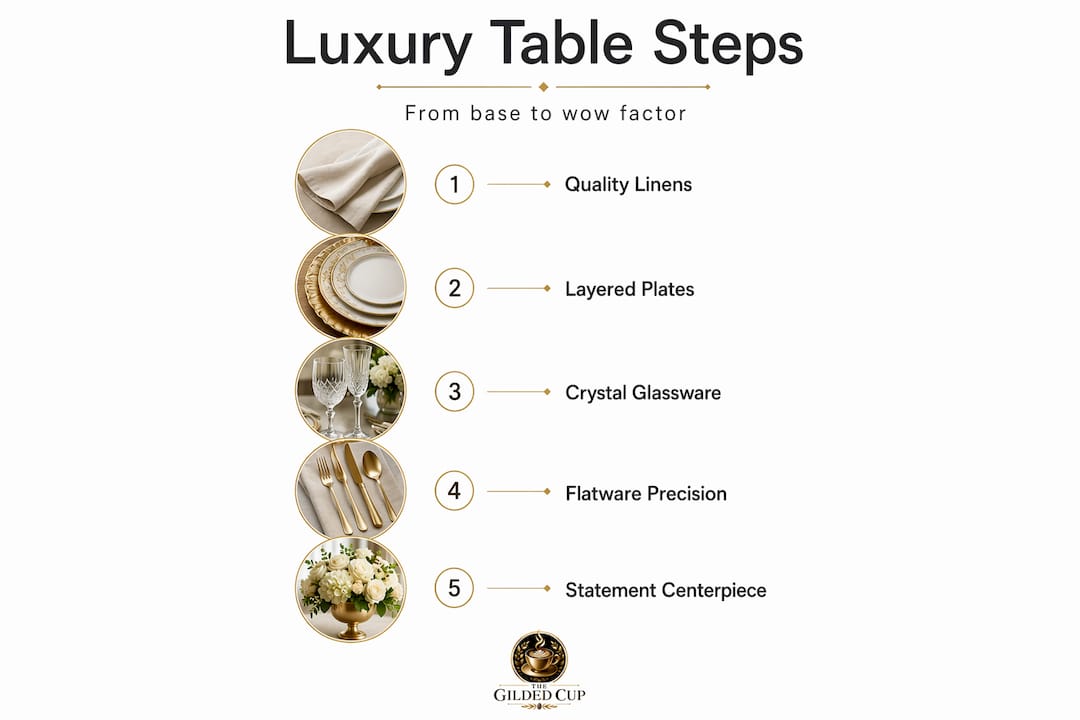
Before you place a single plate, you need to know what belongs on the table. A standard luxury setting includes eight distinct pieces of tableware per person for a multi-course presentation: a charger plate, a dinner plate, a soup bowl, a bread plate, a butter knife, and three or more pieces of flatware per side. That is before glassware even enters the picture.
Here is what you need to gather before you begin:
- Charger plates: These are purely decorative bases, never used to hold food directly. Choose silver, gold-rimmed, or textured designs in ceramic or metal.
- Dinner and salad plates: Fine bone china or porcelain with a consistent design language across the set.
- Flatware: Heavy silver or silver-plated cutlery with hand-polished surfaces and refined geometry. Stainless steel works, but the weight and finish of silver-plate signals a different caliber entirely.
- Glassware: At minimum, a water glass, a red wine glass, and a white wine glass per person. For a full formal setting, add a champagne flute and possibly a dessert wine glass.
- Tablecloth and runner: High-quality linen or cotton, hand-finished, with a soft molleton underlay beneath.
- Napkins: Pressed linen napkins in a complementary color. Avoid polyester blends entirely.
- Decorative accents: Napkin rings in metal or stone, place cards, a centerpiece, and optional candle holders.
| Item | Purpose | Quality standard |
|---|---|---|
| Charger plate | Decorative base for dinner plate | Metal, ceramic, or lacquer with refined finish |
| Flatware set | Utensils for each course | Silver or silver-plated, hand-polished, heavy gauge |
| Crystal glassware | Beverages throughout meal | Lead-free crystal or hand-blown glass |
| Linen tablecloth | Foundation textile | 100% linen or cotton, starched and pressed |
| Molleton underlay | Protects table, softens sound | Thick flannel or felt layer beneath tablecloth |
| Napkins | Personal table linen | Pressed linen, minimum 50x50 cm |
| Centerpiece | Visual focal point | Floral, botanical, or sculptural |
Pro Tip: If you are investing in one area, make it glassware. Guests notice the weight and clarity of a proper wine glass long before they notice your charger plate. The Thegildedcup designer glassware guide explains exactly what separates crystal from standard glass.
Step-by-step instructions to arrange your table
Execution is where most hosts lose the thread. The layout of a luxury table follows classical French service principles, and the sequence matters as much as the items themselves.
-
Lay the textile foundation first. Place your molleton underlay flat on the table. Then center your tablecloth. For a formal setting, the tablecloth drop should be 10 to 15 inches on each side. If using a runner, it should cover approximately one-third of the table width, centered lengthwise.
-
Set the charger plates. Place each charger directly in front of the chair, centered. The bottom edge of the charger sits exactly 2 cm from the table edge. This is not approximate. Use a small ruler for your first few placements and your eye will calibrate.
-
Add dinner plates and bowls. The dinner plate goes on top of the charger, perfectly centered. If you are serving soup as a first course, the soup bowl sits on top of the dinner plate. A side plate for bread goes above and to the left of the charger.
-
Arrange the flatware. Work from the outside in, matching each utensil to its course. Forks go on the left, knives and spoons on the right. All flatware should be spaced 1 cm apart and aligned at the base, with bottoms sitting 2 cm from the table edge. The butter knife rests horizontally across the bread plate.
-
Position the glassware. Start with the water glass, placed directly above the dinner knife. The red wine glass goes to its right and slightly lower. The white wine glass sits to the right of the red. A champagne flute, if used, sits furthest right or slightly behind. For proper champagne service etiquette at formal events, the Thegildedcup champagne glass guide covers positioning and protocol in detail.
-
Fold and place napkins. A simple bishop’s hat or French fold reads more elegantly than elaborate origami. Place the napkin either on top of the charger or to the left of the forks, with a napkin ring if you are using one.
-
Add place cards and final accents. Place cards sit above the charger, centered. They signal care and intention to guests before the meal even begins.
Pro Tip: Photograph one complete place setting from directly above before your guests arrive. This gives you a reference point to catch any asymmetry that your eye missed at table level.
Designing the tablescape: color, texture, and centerpieces
The table setting itself is architecture. The tablescape is interior design. Once your place settings are down, you are building atmosphere.
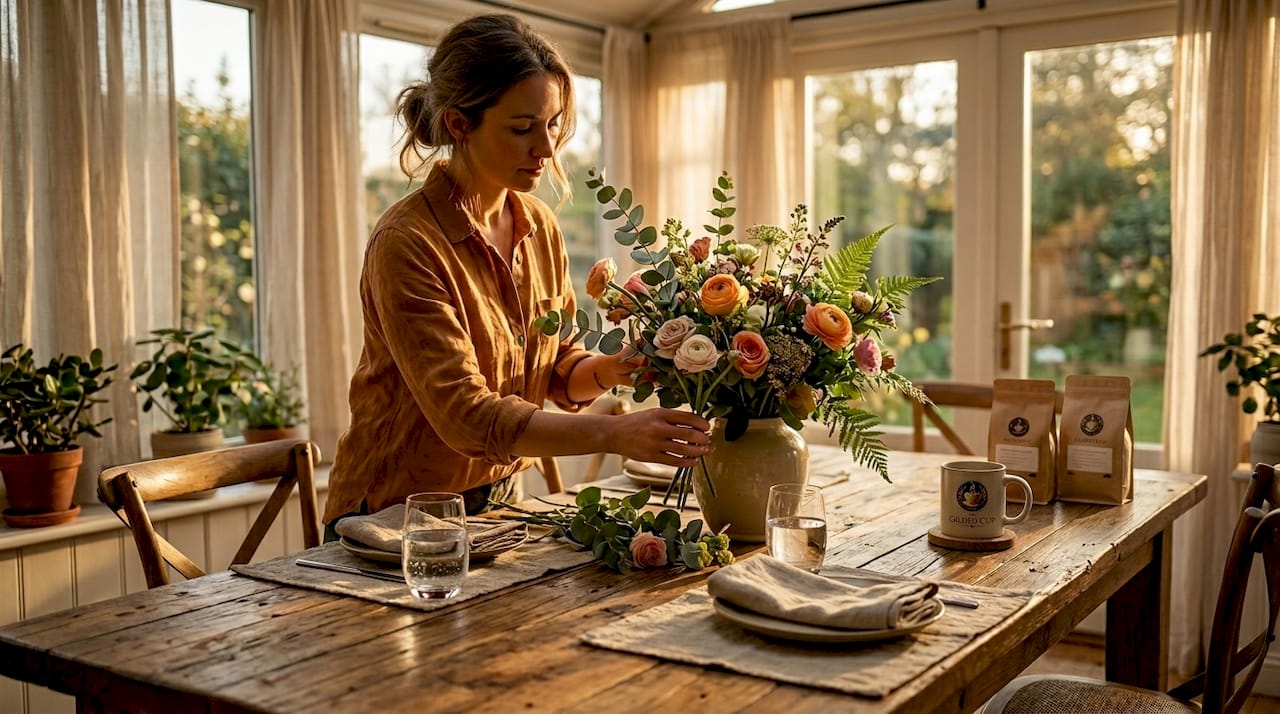
Start from the bottom with your linen quality and color palette. A warm ivory or crisp white linen reads as universally formal. Deeper tones like slate, burgundy, or forest green work beautifully for winter or evening events. Whatever you choose, keep the palette to two or three tones maximum across all table elements.
Texture layering is where the table comes alive. A smooth linen tablecloth pairs well with a woven or embroidered runner. Matte ceramic plates contrast richly against polished silver flatware. Mixing textures and heights creates visual depth that a single-material table cannot achieve.
For centerpieces, height is the critical variable. Low arrangements of garden roses, ranunculus, or seasonal botanicals let guests see each other across the table, which is the point of a dinner. Tall candelabras work only if they are slender enough not to block sightlines. A row of premium candle holders spaced evenly down the center creates warmth without obstruction.
Do’s and don’ts for luxury tablescape styling:
- Do use an odd number of centerpiece elements for a more natural, asymmetric arrangement.
- Do match your metallic accents across napkin rings, candlesticks, and charger rims.
- Don’t mix gold and silver hardware in the same setting. Choose one metal family and commit.
- Don’t use heavily scented flowers near the dining table. They compete with food aromas.
- Do test your table at night under your event lighting before guests arrive. Color and material read completely differently under candlelight versus overhead fixtures.
- Don’t let the centerpiece be so tall or wide that it requires guests to shift in their chairs to hold eye contact.
Pro Tip: A single trailing greenery element, like eucalyptus or olive branch, running the length of the table costs almost nothing and adds organic warmth that flowers alone cannot replicate.
Seating arrangements and guest comfort
A beautiful table setting loses half its impact if guests are physically uncomfortable. This is the detail most event hosts underestimate.
The ergonomic standard for dining comfort is 28 to 30 cm of clearance between the chair seat and the underside of the table. Chairs that are too high create shoulder tension within twenty minutes. Chairs that are too low leave guests hunching forward, which is both uncomfortable and unflattering.
For chair selection, carver chairs at the head and foot of the table with armless side chairs along the length is the classic formal arrangement. Carver chairs confer visual authority to the hosts while allowing armless chairs to seat more guests along the sides without crowding.
| Chair type | Best position | Spacing consideration |
|---|---|---|
| Carver (with arms) | Head and foot of table | Requires wider spacing: 70 to 80 cm per seat |
| Armless side chair | Along table length | Standard 60 to 65 cm per seat is comfortable |
| Upholstered side chair | Formal seated dinners | Adds luxury feel; match fabric to table palette |
For cocktail receptions or mixed-format events, note that only 20 to 30% of guests typically require dedicated seating at any one time. Knowing this lets you balance seated table areas with standing space without overcrowding the room.
Common mistakes that undermine luxury table settings
Even well-prepared hosts make these errors.
- Overcrowding the surface. Too many decorative elements, redundant utensils, or oversized centerpieces create visual noise. Overcrowding undermines the luxury aesthetic as reliably as using cheap products.
- Skipping the underlay. A tablecloth laid directly on bare wood creates that hollow, sliding feeling that reads immediately as informal. The molleton layer is invisible to guests but felt with every movement.
- Misaligned glassware. Glasses that drift forward or bunch together look like a bar setup, not a formal dining table. Set them with the same precision as your flatware.
- Inconsistent metal finishes. Mixing brushed silver flatware with gold charger rims and bronze napkin rings creates visual confusion. Choose a finish and repeat it.
- Using mass-market tableware. The weight of a plate and the ring of a wine glass communicate quality instantly. No amount of decoration recovers from a flimsy dinner plate.
Pro Tip: Walk the perimeter of your table as a guest would, looking at each place setting from above and then at eye level. You will spot asymmetry and misalignment that you cannot see from the host’s end.
My honest take on what makes a luxury table setting actually work
I’ve spent years studying beautifully set tables at high-end events, and I’ll tell you what separates the ones that genuinely impress from the ones that just look expensive in photographs. It is almost never the cost of the individual items. It is the discipline of execution.
The hosts who get this right are the ones who treat the table as a system rather than a collection of pretty objects. Every piece has a reason to be where it is. Nothing is placed casually. When I first started applying Michelin-style precision to personal dinner parties, the reaction from guests changed noticeably. Not because I had spent more money, but because the table felt intentional in a way they could sense without articulating.
What I’ve learned is this: etiquette rules are not arbitrary. The reason flatware is spaced 1 cm apart and chargers sit 2 cm from the edge is that these proportions are visually balanced at eye level. When you deviate from them, even slightly, something feels off to guests without them knowing why. That subtle discomfort is the opposite of what a luxury setting should create.
My favorite personal touch is a single handwritten place card for each guest. At a table set with crystal and pressed linen, a card in your own handwriting says “I thought about you specifically.” No product can replicate that.
Experiment within the rules. Change your color palette by season. Try a sculptural centerpiece instead of florals. Use bespoke drinkware that tells a story. The framework is classical. What you bring to it should be entirely yours.
— Sharbel
Elevate your table with Thegildedcup

The glassware on your table does more work than any other single element. It catches the light, signals quality to every guest the moment they sit down, and frames every pour throughout the meal. Thegildedcup curates a selection of luxury drinkware, fine ceramics, and collectible glassware designed specifically for hosts who want every detail to count. From elegant enamel pieces like the Thegildedcup enamel mug to premium bar accessories for upscale entertaining, the collection gives you pieces worth placing on a table you’ve worked hard to perfect. Browse the full range and find what your table is missing at Thegildedcup.
FAQ
What is the correct number of pieces in a luxury place setting?
A classical luxury place setting includes eight pieces per person, covering charger, dinner plate, soup bowl, bread plate, butter knife, and multiple flatware pieces for each course.
How far from the table edge should plates and cutlery be placed?
Every piece of tableware should sit exactly 2 cm from the table edge, with individual flatware pieces spaced 1 cm apart. This precision creates the symmetry that defines a Michelin-style formal setting.
What tablecloth drop is appropriate for a formal luxury table?
A formal tablecloth should have a 10 to 15 inch drop on each side. A runner, if used, should span approximately one-third of the table width.
What type of chairs work best for a luxury seated dinner?
Carver chairs with armrests at the head and foot of the table, paired with armless upholstered chairs along the sides, create the right balance of grandeur and practicality. Confirm that chair seat height allows 28 to 30 cm of clearance beneath the tabletop.
What is the biggest mistake hosts make when setting a luxury table?
Using mass-market or mismatched tableware is the most common error. No amount of decoration compensates for lightweight plates or cheap glassware. The weight, finish, and clarity of your tableware set the tone before a single dish is served.