

Glassware Grading Explained: A Professional's Guide
Glassware grading is the systematic classification of glass pieces by measurement accuracy, craftsmanship quality, and safety compliance. Whether you work in analytical chemistry, hospitality procurement, or luxury retail, understanding glassware grades determines which pieces are fit for purpose and which create liability. The two primary frameworks are laboratory accuracy grading, governed by ISO 648, ISO 1042, and ASTM standards, and commercial quality grading, which relies on physical inspection protocols and chemical safety testing. Both systems exist to match glassware to its intended environment. Getting that match wrong costs money, accuracy, and sometimes safety.
What does glassware grading mean for lab and commercial use?
Glassware grading classifies pieces according to their tolerance limits, material purity, and compliance with recognized standards. The term covers two distinct but related systems. Laboratory grading focuses on volumetric accuracy and calibration traceability. Commercial grading focuses on physical defects, structural integrity, and food-contact safety.
The distinction matters because the criteria are not interchangeable. A Class A volumetric flask rated to ISO 1042 tells you nothing about lead migration risk. A commercial drinkware piece that passes heavy metal testing tells you nothing about its volumetric accuracy. Professionals who conflate the two systems make poor procurement decisions.
Grading is about functional fitness within a measurement or use system, not just build quality. That framing is the most useful starting point for anyone learning how to grade glassware across different professional contexts.

What are Class A and Class B laboratory glassware?
Volumetric glassware is graded into Class A and Class B, with Class A carrying stricter tolerance limits for analytical accuracy and Class B carrying tolerances that are generally double those of Class A. Both classes are calibrated at 20 °C. That calibration temperature is fixed by ISO 648 and ISO 1042 and applies globally.
Class A glassware is marked with its accuracy class, the calibration basis (either TC for “to contain” or TD for “to deliver”), the nominal volume, and the manufacturer’s lot number. These markings are not decorative. They are the traceability chain that connects a measurement to a recognized standard. Auditors under ISO/IEC 17025 require this chain to be unbroken.
Class B glassware carries the same marking conventions but with wider allowed error bands. It suits general laboratory work, student training, and preparatory tasks where sub-milliliter precision is not critical. Using Class B for routine dilutions and Class A only for final volumetric steps is standard practice in well-run labs.
| Feature | Class A | Class B |
|---|---|---|
| Tolerance | Tightest allowed by ISO/ASTM | Approximately double Class A |
| Calibration temperature | 20 °C | 20 °C |
| Typical use | Critical analytical measurements | General lab work, education |
| Certificate required | Yes, for audit traceability | Recommended but not always required |
| Marking | Class A, TC or TD, volume, lot | Same conventions, wider bands |
Pro Tip: Map your method’s uncertainty budget before ordering. Assign Class A only to the volumetric steps that directly affect your final result. Using Class A everywhere inflates cost without improving data quality.
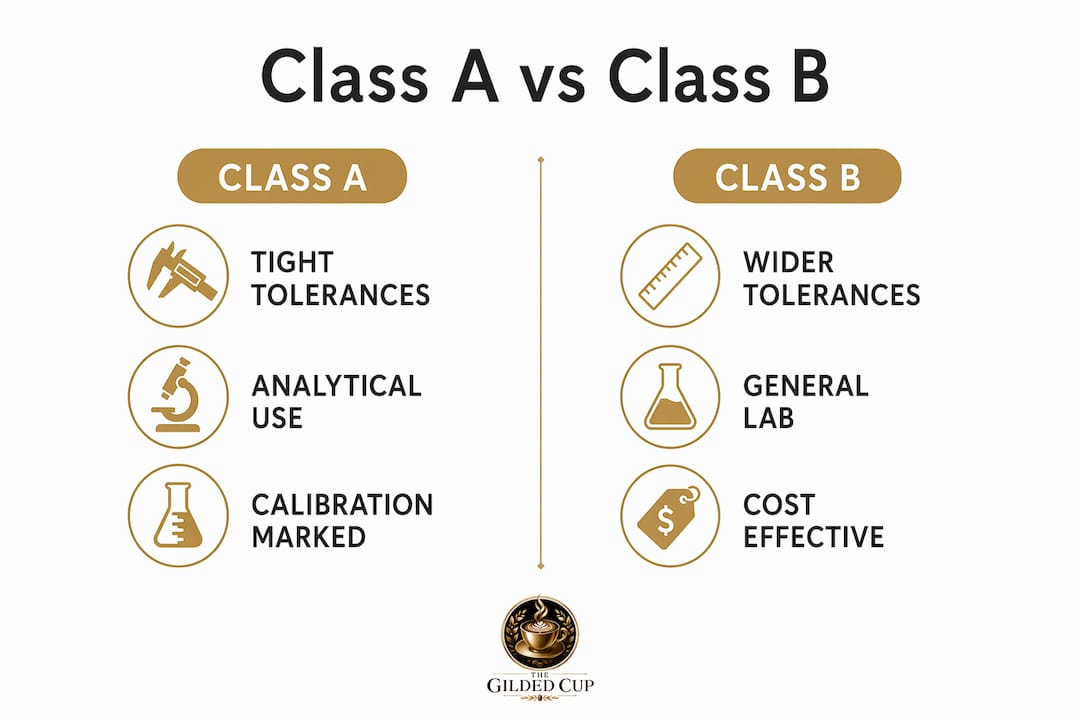
Labs that map uncertainty budgets assign Class A glassware to critical steps and Class B elsewhere, with both documented in validation files. That practice keeps audit files clean and procurement costs controlled.
How is commercial glassware graded for quality and safety?
Commercial glassware grading uses physical inspection and chemical testing to confirm that a batch meets defined quality benchmarks before shipment. The five core defect areas are rim smoothness, capacity consistency, logo and decoration accuracy, base stability, and structural inclusions such as bubbles or stones in the glass body.
Effective inspection combines onsite physical defect checks with third-party laboratory testing for lead and cadmium migration on food-contact items. Physical checks catch visible defects. Lab testing catches invisible chemical risks that no visual inspection can detect. Both are non-negotiable for food-contact drinkware sold in regulated markets.
Rim smoothness and base stability are the two most critical physical checks. A rough rim creates a cutting hazard and signals poor fire-polishing. An unstable base causes tipping, which generates breakage claims and liability exposure. These two checks alone filter out the majority of substandard commercial pieces.
Essential quality checks before approving a bulk order:
- Rim finish: Run a fingertip around the full circumference. Any roughness or sharp edge is a reject.
- Capacity consistency: Fill a sample set to the stated volume and weigh each. Variance beyond the specified tolerance fails the batch.
- Base stability: Place each piece on a flat surface without support. Any rocking motion is a structural defect.
- Decoration accuracy: Compare logo placement, color, and coverage against the approved sample. Deviation beyond the agreed tolerance is a reject.
- Wall inclusions: Hold each piece to a light source. Bubbles, stones, or cords in the glass wall indicate a forming defect.
Pro Tip: Always establish a physical approved sample before mass production begins. That sample becomes the legal quality benchmark for the entire order. Without it, disputes over rim finish or decoration accuracy have no objective reference point.
Failing to establish an approved sample before mass production is the single most common and costly commercial glassware procurement mistake. The approved sample defines the grade. Everything else is just opinion.
For a practical checklist of what separates acceptable from premium commercial drinkware, the quality indicators guide at Thegildedcup covers the key markers in detail.
What international standards govern glassware grading?
ISO and ASTM standards form the backbone of laboratory glassware grading. ISO 648 covers single-volume and graduated pipettes. ISO 1042 covers one-mark volumetric flasks. Both standards set the allowed error bands and calibration marks that ensure traceability and method integration. ASTM E438 and ISO 4796-1 address glass material purity and chemical resistance for labware.
Certificates of Conformity are the documentary proof that a batch of glassware meets the stated standard. In ISO/IEC 17025 audit environments, auditors require traceable documentation proving glassware meets the uncertainty requirements of the method it supports. A certificate without a lot number traceable to the physical glassware in use is not sufficient.
| Standard | Scope | Key requirement | Typical marking |
|---|---|---|---|
| ISO 648 | Pipettes | Accuracy class, calibration basis | Class A or B, TC/TD, volume |
| ISO 1042 | Volumetric flasks | Tolerance limits, temperature reference | Class A or B, 20 °C, volume |
| ASTM E438 | Borosilicate glass types | Material purity classification | Type I or Type II |
| ISO 4796-1 | Laboratory glassware general | Chemical resistance, material type | Material designation |
| ISO/IEC 17025 | Lab competence and audit | Traceability of measurements | Accreditation scope |
Grading documentation fits directly into method validation files. When a lab validates an analytical method, the uncertainty budget must account for the volumetric contribution of each piece of glassware used. That contribution is defined by the glassware’s grade. A Class A 100 mL volumetric flask contributes a smaller uncertainty than a Class B flask of the same volume. The grade is not a label. It is a number that feeds into your measurement math.
How does glass material type affect glassware grading?
Glass composition determines chemical behavior, and chemical behavior determines fitness for purpose in ways that accuracy class alone cannot capture. The two most common material types in laboratory and commercial glassware are borosilicate glass and soda-lime glass.
Borosilicate glass, classified as Type I under ASTM E438 and ISO 4796-1, offers high chemical resistance and low thermal expansion. It is the standard material for analytical laboratory glassware. Soda-lime glass is less chemically resistant and more prone to leaching under acidic or high-temperature conditions. It dominates commercial drinkware production because it is less expensive to form and fire-polish.
The critical insight is that borosilicate glass can leach boron, sodium, and silicon under acid or heat conditions, even when labeled as high-grade. That leaching is invisible to accuracy grading. A Class A borosilicate flask is still the right choice for most analytical work. But for ultrapure or trace-metal applications, even Type I borosilicate introduces contamination that invalidates results.
Key material considerations when selecting glassware beyond accuracy class:
- Type I borosilicate: Best for general analytical chemistry, autoclaving, and most organic solvents.
- Quartz or fused silica: Required for ultrapure, UV-transparent, or extreme-temperature applications where borosilicate leaching is unacceptable.
- Soda-lime: Suitable for commercial drinkware and non-critical preparatory lab work. Not suitable for acidic or high-temperature analytical steps.
- Acid-washed or certified-clean glassware: Necessary for trace-metal analysis regardless of material type.
Matching material type to chemical environment is a separate decision from selecting accuracy class. Both decisions must be made together. A piece of glassware can carry the correct accuracy grade and still be the wrong choice for the application if the material is incompatible with the chemistry involved. For buyers matching glass types to specific beverage or use environments, the hospitality-grade glassware guide at Thegildedcup addresses this intersection clearly.
The difference between borosilicate and soda-lime also matters in commercial contexts. Understanding glass versus crystal distinctions helps buyers make informed decisions about material composition when evaluating premium drinkware.
Key Takeaways
Glassware grading requires matching accuracy class, material type, and safety compliance to the specific demands of the application, not selecting the highest grade available across the board.
| Point | Details |
|---|---|
| Class A vs. Class B | Class B tolerances are double those of Class A; use Class A only where your uncertainty budget demands it. |
| Approved samples are non-negotiable | Establish a physical quality benchmark before mass production to avoid costly commercial disputes. |
| Standards drive traceability | ISO 648, ISO 1042, and ASTM E438 define the markings and certificates that connect glassware to audit-ready documentation. |
| Material type is a separate decision | Borosilicate can leach trace elements under acid or heat; match material to chemistry, not just accuracy class. |
| Commercial grading covers five defect areas | Rim smoothness, capacity consistency, decoration accuracy, base stability, and structural inclusions all require inspection. |
Why grading is more nuanced than most buyers realize
The biggest misconception I encounter is that a higher grade means universally better glassware. It does not. Grade describes fitness for a defined purpose within a defined measurement system. A Class A volumetric flask is the right tool for a critical dilution step in an accredited lab. It is not inherently superior to a well-made commercial tumbler for a hospitality buyer whose priority is rim durability and stackability.
The second misconception is that passing a chemical safety test means the glass is inert. It means the glass passed a specific test under specific conditions. Borosilicate labeled as high-purity still leaches ions under the wrong conditions. Commercial drinkware that passes lead migration testing at room temperature may behave differently with hot acidic beverages over repeated dishwasher cycles.
What I advise professionals to do is build a grading decision matrix before procurement. List the application, the accuracy requirement, the chemical environment, the regulatory requirement, and the audit documentation needed. Then select grade and material together. That process eliminates most procurement errors before they happen.
Proactively auditing your glassware inventory twice a year also catches grade drift, which is what happens when Class A pieces get mixed into general stock and lose their traceability documentation. Once the certificate is separated from the physical piece, the grade is unverifiable. That is an audit failure waiting to happen.
— Sharbel
Quality glassware, graded to perform
Thegildedcup curates premium drinkware and fine glassware selected for craftsmanship, material quality, and lasting performance. Every piece in the collection reflects the same grading principles covered in this guide: rim finish, structural integrity, material suitability, and consistency across a batch.
Whether you are sourcing for a hospitality program, building a personal collection, or gifting for a special occasion, the Thegildedcup collection gives you access to glassware that has been evaluated against real quality criteria. The blog also covers topics from glassware provenance to care and maintenance, giving buyers the context they need to make informed decisions at every price point.
FAQ
What is the difference between Class A and Class B glassware?
Class A glassware carries tighter tolerance limits for critical analytical measurements, while Class B tolerances are approximately double those of Class A. Both are calibrated at 20 °C under ISO and ASTM standards.
What standards govern laboratory glassware grading?
ISO 648 covers pipettes, ISO 1042 covers volumetric flasks, and ASTM E438 addresses borosilicate glass material purity. ISO/IEC 17025 sets the audit framework that requires traceable Certificates of Conformity for accredited labs.
What are the five defect areas in commercial glassware grading?
Commercial glassware inspection covers rim smoothness, capacity consistency, logo and decoration accuracy, base stability, and structural inclusions such as bubbles or stones in the glass wall.
Does borosilicate glass always perform better than soda-lime glass?
Not for every application. Borosilicate offers higher chemical resistance but can leach boron and sodium under acid or heat conditions. Soda-lime is suitable for most commercial drinkware where those conditions do not apply.
Why is an approved sample critical in commercial glassware procurement?
An approved sample defines the physical quality benchmark for the entire production run, covering appearance, rim finish, and structural stability. Without it, there is no objective standard against which to reject a non-conforming batch.