

Elegant bar accessories list: the affluent collector's guide
Building a home bar that genuinely impresses requires more than stocking good bottles. The real challenge is assembling an elegant bar accessories list that balances beauty, function, and workflow without tipping into clutter. Too many tools create chaos; too few leave you improvising in front of guests. This guide covers every essential piece, from the shaker in your hand to the glassware on the tray, with the selection criteria, comparisons, and styling insights that collectors and serious home entertainers actually need.
Table of Contents
- Criteria for curating an elegant bar accessories list
- Essential bar tools for an elevated home bar
- Curated glassware to match cocktails with style and function
- Comparing elegant bar accessories: a side-by-side guide
- Styling and organizing your elegant bar accessories
- Why true bar elegance comes down to workflow and presentation mastery
- Elevate your home bar with curated elegant accessories from The Gilded Cup
- Frequently asked questions
Key Takeaways
| Point | Details |
|---|---|
| Core essentials | Six fundamental bar tools and four glassware types cover nearly all classic cocktails elegantly. |
| Workflow matters | Organizing your bar by prep, mixing, and service zones enhances efficiency and elevates hosting. |
| Presentation control | Measured pours and cohesive display elevate your bar’s appearance and guest experience. |
| Stylish containment | Use trays and layered styling to prevent clutter and add visual polish to your bar setup. |
| Lighting and height | Layered lighting and the right bar height create ambiance and practical comfort for your guests. |
Criteria for curating an elegant bar accessories list
Before buying anything, you need a framework. The most common mistake is treating bar setup as a shopping list rather than a design problem. Every piece you add should earn its place by serving at least one of four criteria: it covers a core cocktail technique, it matches your glassware aesthetic, it supports your workflow, or it contributes to presentation.
The four pillars of selection:
- Utility first. Prioritize tools that cover stirring, shaking, straining, measuring, and muddling. These five techniques account for nearly every classic cocktail.
- Aesthetic consistency. Mixing brushed brass with matte black with chrome looks accidental, not curated. Pick a finish and commit to it across your tools and vessels.
- Workflow zoning. An elevated home bar’s success depends on layout and workflow done well, not the quantity of accessories you own. Divide your surface into prep, mix, and serve zones before placing anything.
- Presentation control. Measured pour systems and organized bottle arrangements are what distinguish a collector’s setup from a casual one.
A well-chosen black glossy mug or a whiskey barrel aged vessel, for example, adds both function and a strong visual anchor to your bar surface without requiring additional styling effort.
With the criteria clear, let’s explore the essential bar tools that every elegant home bar needs.
Essential bar tools for an elevated home bar
The tools you reach for every time you make a drink define the character of your bar. Owning the right ones in quality materials makes the difference between a setup that looks professional and one that looks assembled from a gift set.
The core toolkit:
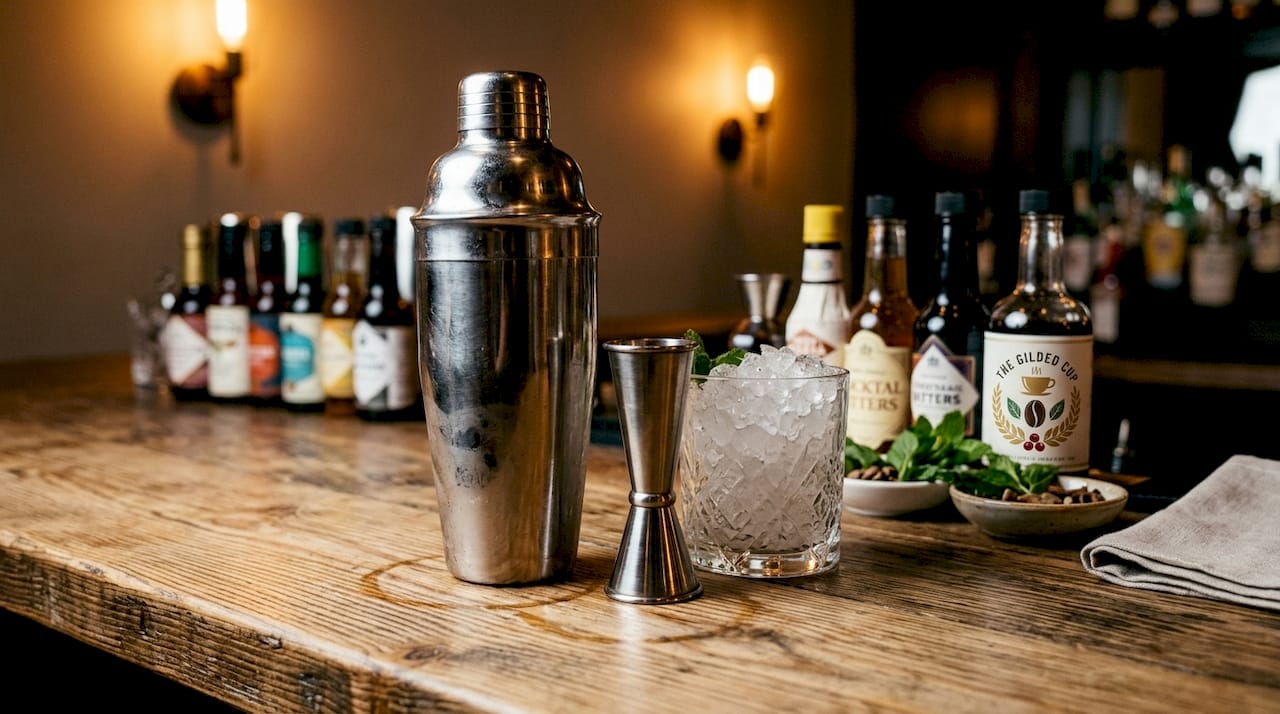
- Shaker. The Boston shaker (two-piece tin-on-tin or tin-on-glass) is the professional standard. It offers larger volume, faster chilling, and a satisfying seal. The cobbler shaker (three-piece with built-in strainer) is more forgiving for beginners and easier to handle without practice. For a refined home bar, the Boston shaker signals seriousness.
- Double-sided jigger. Core bar tools include a double-sided jigger as non-negotiable for precision. The standard sides measure 1 oz and 1.5 oz, covering the vast majority of recipes. Never eyeball.
- Hawthorne strainer. The coiled spring on a Hawthorne strainer catches ice chips and pulp when pouring from a shaker. It fits snugly over a Boston tin and is the fastest, most reliable option for daily use.
- Fine-mesh strainer. Used in addition to the Hawthorne for double-straining, it removes tiny ice shards and herb particles, producing a noticeably cleaner, more polished pour.
- Bar spoon. A long-handled bar spoon (typically 12 inches) lets you stir without splashing and layer ingredients by pouring gently over the back of the spoon. The twisted handle isn’t decorative; it controls liquid flow.
- Flat-headed muddler. A flat head works on both herbs and fruits without tearing leaves or releasing bitter compounds from citrus pith. Avoid the toothed version for anything delicate.
- Citrus press. Fresh juice is one of the highest-leverage upgrades in cocktail making. A hand-held citrus press extracts more juice with less effort than a reamer and keeps seeds out of the glass.
Pro Tip: Buy your shaker and jigger as a matched set in the same finish. These two tools are in your hand on every drink, so visual cohesion here pays the biggest aesthetic dividend of anything on the list.
Having covered tools, next we examine the essential glassware shapes that define cocktail elegance.
Curated glassware to match cocktails with style and function
Glassware is where function and elegance intersect most visibly. The wrong glass doesn’t just look off; it actively changes how a drink smells, tastes, and holds temperature. You don’t need twelve glass types. You need four, chosen well.
The essential four:
- Rocks glass (also called an Old Fashioned glass). Wide, heavy, and low, it’s built for spirits served neat or over a large ice cube. The wide mouth lets aromas open up and makes it easy to muddle directly in the glass. This is the most versatile vessel on the list.
- Highball glass. Tall and narrow, it keeps carbonation from escaping too quickly and holds ice submerged, which slows dilution. Essential for any long drink: gin and tonic, whiskey soda, or a Paloma.
- Coupe glass. The coupe has displaced the martini glass in serious cocktail circles for good reason. The rounded bowl is harder to spill, more elegant in profile, and better at containing aromas than the wide-V martini glass. Use it for anything served “up” (chilled, no ice).
- Wine glass. Adding a set of wine glasses covers guests who prefer wine and doubles as a vessel for spritzes and some sparkling cocktails. Glassware elegance comes from matching types to drinks: rocks for spirits on ice, highball for long fizzy drinks, coupes for shaken cocktails.
Fewer types also mean less storage pressure. Four glass types, each in a set of four to six, covers most entertaining scenarios without requiring a dedicated cabinet. Explore curated glassware sets that balance visual cohesion with practical variety.
With tools and glassware defined, let’s now compare these essentials side-by-side to guide your selections.
Comparing elegant bar accessories: a side-by-side guide
Knowing what each tool does is one thing. Knowing how to choose between similar options is where most people stall. This comparison table cuts through the noise.
| Accessory | Best for | Trade-off | Recommended finish |
|---|---|---|---|
| Boston shaker | Speed, volume, professional results | Requires practice to seal and open | Brushed steel or hammered copper |
| Cobbler shaker | Beginners, casual entertaining | Slower, smaller capacity | Matte black or polished silver |
| Double-sided jigger | Precise measurement, balanced drinks | None worth noting | Match your shaker finish |
| Hawthorne strainer | Primary ice/pulp filtration | Misses very fine particles | Steel with gold accent |
| Fine-mesh strainer | Double-straining for silky texture | Slower pour, extra step | Neutral steel |
| Rocks glass | Spirits neat or on ice | Limited to short drinks | Crystal clear or smoked |
| Highball glass | Long drinks, carbonated cocktails | Not suitable for “up” cocktails | Thin-walled crystal |
| Coupe glass | Shaken or stirred cocktails served up | Easier to spill if overfilled | Etched crystal or plain |
Using a Boston shaker with a Hawthorne strainer plus an optional fine-mesh strainer achieves the smoothest cocktail texture, which is what separates a home bartender’s output from a professional one.
Pro Tip: When selecting black glossy mugs or premium whiskey barrel accessories for your bar, check that the glaze or finish holds up to both hot and cold liquids. A piece that works across drink temperatures earns its shelf space twice over.
Now that you know the essential pieces and their comparisons, let’s explore how to style and arrange your bar for luxurious entertaining.
Styling and organizing your elegant bar accessories
A well-stocked bar that looks disorganized still reads as amateur. Styling is not decoration for its own sake; it directly affects how smoothly you can work and how guests perceive the space.
Six principles for a polished bar setup:
- Use trays as anchors. Trays, layered objects, and coordinated materials prevent the flat, one-level look that makes bar carts feel like hardware displays. A leather or hammered metal tray groups your most-used tools and creates a visual boundary between zones.
- Add vertical interest. Stack books, stands, or risers beneath bottles or decanters. Height variation gives the eye somewhere to travel and makes the setup feel intentional rather than placed.
- Zone your workflow. Elegant bar workflow divides into prep, mixing, and service zones with tailored lighting and appropriate surface heights for each. Keep your muddler and citrus press in the prep zone, shaker and jigger in the mix zone, and glassware and garnishes in the serve zone.
- Layer your lighting. A single overhead light flattens everything. Add a small task light at bar level and consider a backlit shelf or cabinet for bottles. The amber glow through glass is one of the most effective mood-setting tools available.
- Mind the ergonomics. Counter height matters. Standard bar height is 42 inches; counter height is 36 inches. Matching your stool height to your surface keeps guests comfortable and keeps you from hunching while you work.
- Edit ruthlessly. Every decorative accent you add should either reflect your personal aesthetic or serve a function. A beautiful display vessel for cocktail picks earns its place; a random figurine does not.
Key styling accessories to consider:
- Leather or hammered metal serving trays
- Crystal decanters for spirits you use frequently
- Linen or slate coasters in a unified color palette
- A small ice bucket with tongs in a matching finish
- Bitters bottles with glass droppers for visual precision and portion control
Elegant bar organization is ultimately about removing friction. When every tool is exactly where you expect it, you can hold a conversation while you work, which is the real mark of a confident host.
Why true bar elegance comes down to workflow and presentation mastery
Here is the perspective most bar guides avoid: buying more does not make your bar more elegant. It makes it more expensive. The collectors and home entertainers whose bars genuinely impress guests are almost always working with fewer pieces, not more, arranged with deliberate intention.
Luxury bar ambiance depends more on workflow zoning and layered lighting than on the sheer number of accessories present. A bar with twelve tools scattered across a surface signals uncertainty. A bar with six tools placed with precision signals mastery. Guests read that difference immediately, even if they can’t articulate why.
The second underrated factor is measured pours. Collectors emphasize presentation control through measured pour systems and unified bottle organization for both aesthetic and functional excellence. A bitters bottle with a calibrated dropper, a jigger used consistently, and a decanter that replaces a labeled bottle all communicate that the host takes this seriously. These are not expensive upgrades. They are disciplined ones.
The third factor is the one most people skip entirely: practicing the service sequence before guests arrive. Knowing exactly where your ice scoop is, which glass you’re using for which drink, and how long your stir should last means you are never fumbling. Elegance in entertaining is largely the absence of visible effort.
A thoughtful bar accessory selection built around these principles will outperform a larger, less intentional collection every time.
Elevate your home bar with curated elegant accessories from The Gilded Cup
The pieces that anchor a truly refined bar setup are not mass-produced. They are chosen with the same care you bring to the rest of your home.
At The Gilded Cup, every item in the collection is selected to balance form, function, and elevated aesthetics. The black glossy mug collection brings a bold, polished presence to any bar surface, while the whiskey barrel aged accessories add warmth and character suited to serious spirits enthusiasts. For a softer, layered look, the enamel mugs offer a tactile, artisanal quality that distinguishes a curated bar from a generic one. Each piece ships with the quality and finish that collectors expect. Start building your elegant home bar with pieces that will still look exceptional a decade from now.
Frequently asked questions
What are the must-have tools for an elegant home bar?
A shaker, double-sided jigger, Hawthorne strainer, bar spoon, muddler, and citrus press are the foundation. Core tools cover every major cocktail technique without redundancy.
Which glassware types are necessary for a stylish bar setup?
Rocks glasses, highball glasses, coupe glasses, and wine glasses cover the full range of elegant serving needs. Four glass styles serve virtually every drink with the right form and function.
How can I make my home bar look elegant beyond just buying accessories?
Use trays to contain and group tools, divide your surface into workflow zones, and add layered lighting. Organization and containment do more for bar elegance than adding more items.
Is it better to use a Boston shaker or a cobbler shaker at home?
Boston shakers deliver professional speed and larger batch capacity, while cobbler shakers are more intuitive for beginners. The Boston shaker is the professional standard; the cobbler shaker suits casual home use.
How important is precise measurement in cocktail making at home?
Very. Precise jiggers prevent inconsistent pours and keep cocktails balanced, which is the single most common reason home cocktails taste off compared to bar versions.