

Decanting wine step by step: The collector's guide
Knowing how to approach decanting wine step by step separates a good bottle from a transcendent one. Yet most collectors treat decanting as a single, interchangeable act, pouring wine into a vessel and hoping for the best. The reality is more nuanced: decanting serves two distinct purposes, and confusing them risks damaging the very wine you paid a premium to enjoy. This guide walks you through the exact process, from choosing the right vessel to knowing precisely when to stop pouring, so every bottle you open performs at its peak.
Table of Contents
- Understanding why and when to decant wine
- Preparing your wine and tools for decanting
- Step-by-step decanting process for collectors
- Common decanting mistakes and how to avoid them
- Tasting and serving your decanted wine at its best
- Why mastering distinct decanting goals elevates your wine experience
- Enhance your wine experience with elegant tools from The Gilded Cup
- Frequently asked questions
Key Takeaways
| Point | Details |
|---|---|
| Decanting serves two goals | Separate sediment or aerate wine by tailoring technique for each purpose. |
| Preparation is crucial | Store bottles upright and set lighting to spot sediment for a clean pour. |
| Control oxygen exposure | Pour carefully depending on whether you want slow sediment separation or vigorous aeration. |
| Monitor wine while decanting | Taste periodically to catch when the wine is at its flavor peak. |
| Use elegant tools | Choosing the right decanter and glassware enhances both aesthetics and function. |
Understanding why and when to decant wine
Before you touch the bottle, you need to know what you are actually trying to accomplish. Decanting serves two distinct functions: separating sediment from the wine, and exposing the wine to oxygen to soften tannins and open aromas. These are not the same goal, and they require different techniques.
Here is the key distinction most collectors miss: you rarely need both at the same time. A 20-year-old Barolo with visible sediment needs a slow, careful pour with minimal oxygen contact. A three-year-old Napa Cabernet with grippy tannins needs aggressive aeration. Treating both bottles the same way is the most common and costly mistake in a collector’s cellar.
When to prioritize sediment separation:
- Wines over 15 years old, particularly aged Bordeaux, Burgundy, and Rhône reds
- Vintage Port, which throws significant sediment even at 10 years
- Any bottle where you can see particulate matter when you hold it to light
- Wines stored horizontally for years where sediment has settled along the bottle’s side
When to prioritize aeration:
- Young, tannic reds under 8 years old: Cabernet Sauvignon, Syrah, Malbec
- Wines that smell closed or “dumb” immediately after opening
- Full-bodied whites like aged white Burgundy or Viognier that need to open up
- Wines with noticeable sulfur notes on first pour
One critical warning: over-aerating a fragile old wine can strip it of its character within minutes. A 1995 Pomerol that took 25 years to develop its silky complexity can turn flat and lifeless in under an hour if left exposed. Knowing your wine’s age and structure before you begin is not optional. It is the foundation of every decision that follows.
Having understood the why and when, let’s prepare to decant your wine with care.
Preparing your wine and tools for decanting
Preparation is where most collectors cut corners, and it shows in the glass. The right setup before you pour makes the difference between a clean, sediment-free decant and a cloudy, disturbed bottle.
Essential preparation steps:
- Stand the bottle upright for at least 24 hours before decanting to allow sediment to settle to the bottom
- Choose a glass decanter over crystal with lead content for inertness and to let you appreciate the wine’s color as it opens
- Set up a candle or a focused flashlight behind the bottle neck before you begin pouring
- Have a clean, dry decanter at room temperature ready to receive the wine
- Remove the foil capsule completely so you have a clear view of the bottle neck
| Decanter type | Best use | Key advantage |
|---|---|---|
| Narrow-neck, wide-base | Sediment separation | Precision pour control |
| Wide-mouth, flat-base | Young wine aeration | Maximum oxygen surface area |
| Classic elongated | Everyday reds | Versatility across styles |
| Tall, slender | Aged whites and Burgundy | Gentle, controlled exposure |
Pro Tip: If you are working with a bottle that has been stored horizontally for years, stand it upright for 48 hours rather than 24. Sediment that has caked along the bottle’s side needs extra time to migrate fully to the base.
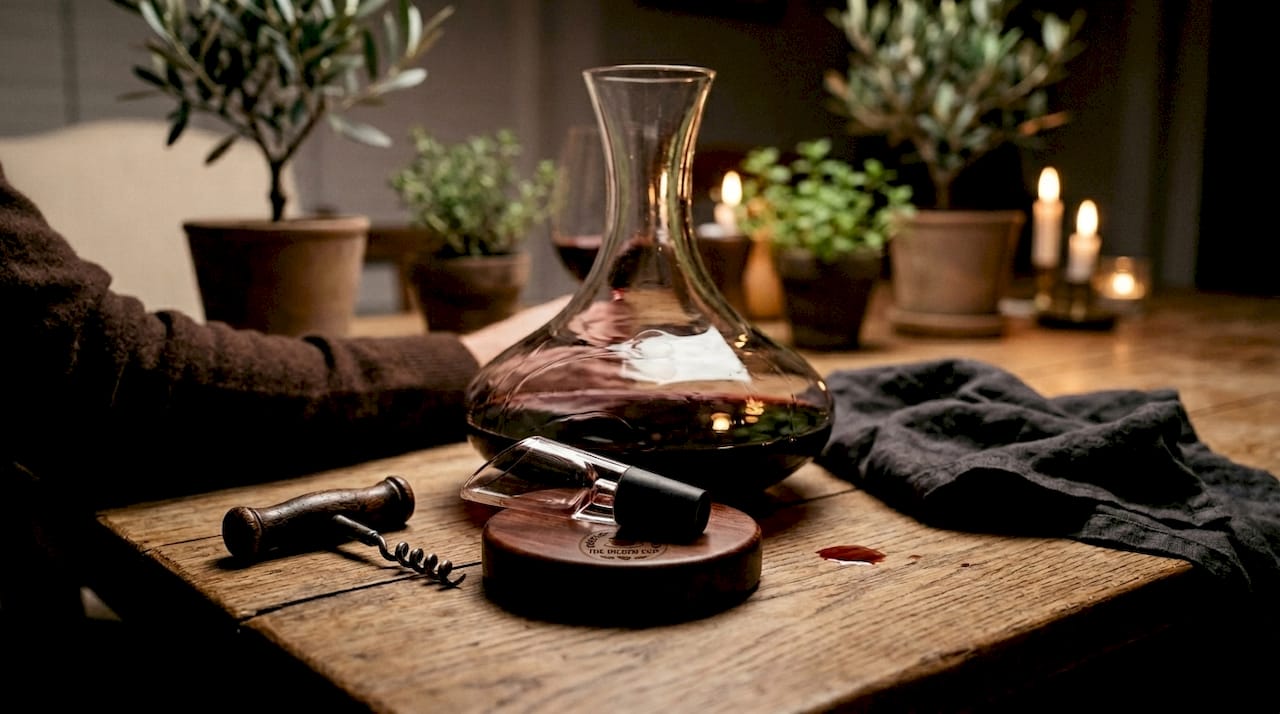
Choosing elegant decanters is as much about function as it is about the ritual. A well-made glass decanter with a narrow neck gives you the control to pour in a single, unbroken stream, which is exactly what sediment separation demands.
With your wine and tools ready, we move on to the decanting process itself.
Step-by-step decanting process for collectors
This is where technique matters most. Follow these steps in order, and you will handle both sediment separation and aeration with the precision they require.
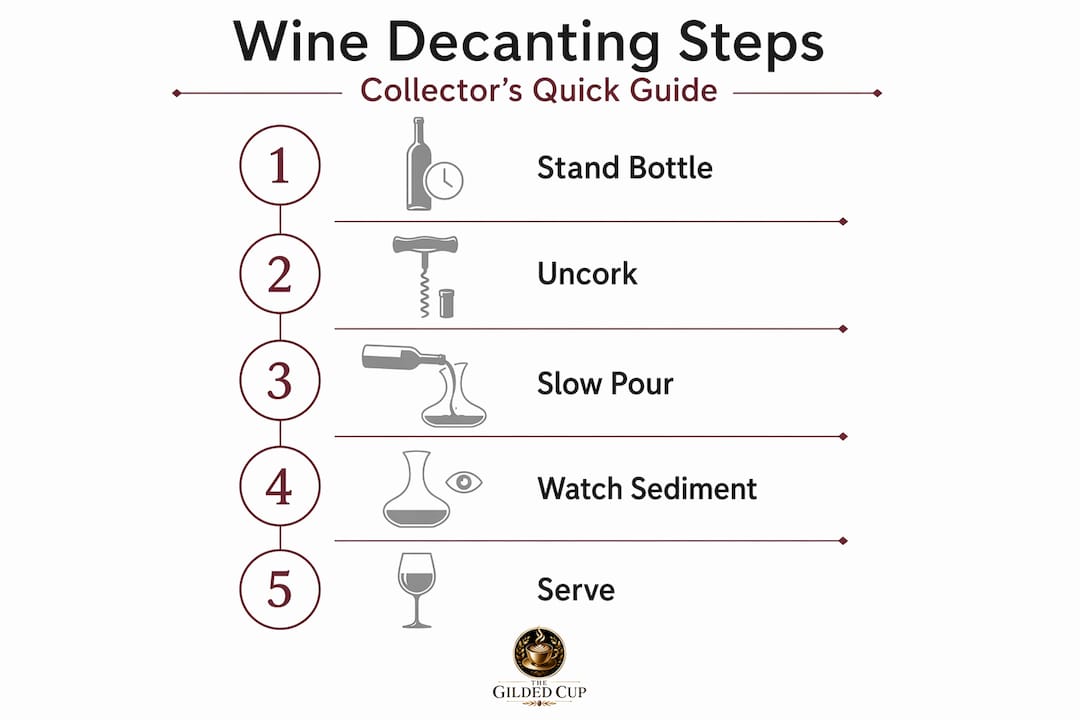
- Open the bottle carefully. Use a waiter’s corkscrew and remove the cork in a single, steady pull. Avoid twisting or jerking, which disturbs the sediment you just spent 24 hours settling.
- Position your light source. Place a candle or flashlight directly behind the bottle neck. You need to see through the glass clearly before the first drop leaves the bottle.
- Begin pouring in a single, continuous stream. Pour slowly and steadily near the bottle neck, keeping the bottle at a consistent angle without stopping and starting. Interrupting the flow stirs sediment.
- Watch the neck, not the decanter. Your eyes should stay on the light source behind the bottle neck. The moment you see the first wisp of sediment approaching the neck, stop immediately.
- For aeration, adjust your pour angle. If your goal is oxygen exposure rather than sediment separation, tilt the decanter so the wine runs down the inside wall. This increases surface contact with air without splashing.
- Time your decant to the wine. Young, tannic reds typically need 30 minutes to 2 hours. Older wines, 15 years and above, rarely need more than 20 to 30 minutes before they start to fade.
| Wine style | Recommended decanting time | Primary goal |
|---|---|---|
| Young Cabernet Sauvignon | 60 to 120 minutes | Aeration |
| Young Syrah or Malbec | 45 to 90 minutes | Aeration |
| Aged Bordeaux (15+ years) | 20 to 30 minutes | Sediment separation |
| Vintage Port | 30 to 45 minutes | Sediment separation |
| Aged Burgundy | 15 to 20 minutes | Minimal aeration only |
Pro Tip: For expert decanting tools that give you the precision to execute a clean pour, look for a decanter with a lip designed to minimize drips. Even a small drip can run back down the bottle and disturb the sediment you are trying to leave behind.
Having mastered the pouring steps, let’s explore common pitfalls and how to avoid them.
Common decanting mistakes and how to avoid them
Even experienced collectors make these errors. Recognizing them before they happen is far easier than recovering a wine that has been handled incorrectly.
“Conflating aeration and sediment separation can lead to over-handling and damage fragile wines.”
Mistakes to watch for:
- Decanting wines over 25 years without tasting first. Extremely old wines can be so fragile that even 10 minutes of air exposure begins to degrade them. Always taste immediately after opening before committing to a full decant.
- Splashing during the pour. Splashing introduces oxygen rapidly and unevenly. If your goal is sediment separation, a splashy pour defeats the purpose entirely and can accelerate deterioration.
- Leaving the wine in the decanter indefinitely. Many collectors decant before guests arrive and forget to monitor the wine. A young Cabernet that was vibrant at 90 minutes can turn flat and one-dimensional by the three-hour mark.
- Using a cold decanter. A chilled glass decanter can drop the wine’s temperature by several degrees, which closes aromas rather than opening them. Rinse your decanter with a small splash of the wine itself before the full pour to bring it to temperature.
- Assuming all red wines need decanting. Light reds like Pinot Noir from cooler climates often perform better poured directly into the glass. Decanting can strip their delicate aromatics before you have a chance to enjoy them.
With these pitfalls in mind, let’s verify when your decanted wine is at its peak for serving.
Tasting and serving your decanted wine at its best
Decanting is not a set-and-forget process. The wine continues to evolve in the decanter, and the window between “not yet open” and “past its peak” can be surprisingly narrow.
How to monitor your decanted wine:
- Taste immediately after decanting to establish a baseline
- Taste again every 15 to 30 minutes to track how the wine is developing
- Note when the tannins soften, the aromas lift, and the finish lengthens. That is your serving window.
- Once the wine reaches that point, serve it promptly rather than waiting
Wine wakes up immediately after decanting and can open further after a short rest, which is why frequent tasting is the most reliable method for timing service. Most wines benefit from 20 to 120 minutes, depending on style and age, but those numbers are starting points, not guarantees.
Serving guidelines by wine style:
- Young, full-bodied reds: serve after 60 to 90 minutes, once tannins feel smoother
- Aged reds: serve as soon as the wine opens, typically within 20 to 30 minutes
- Vintage Port: serve after 30 to 45 minutes, monitoring for fruit freshness
- Full-bodied whites: serve after 15 to 20 minutes, once the nose lifts
Pro Tip: If you are hosting a dinner and need to time service precisely, decant in two stages. Pour half into the decanter first, taste it, and use that reading to decide when to pour the second half. This gives you a rolling window rather than a single, fixed serving moment.
Now that you know how to savor your decanted wine, let’s consider an expert perspective on decanting nuances.
Why mastering distinct decanting goals elevates your wine experience
Here is the opinion that most wine guides will not say plainly: the majority of decanting advice treats the process as a single skill, when it is actually two entirely different disciplines that happen to use the same vessel.
Sediment separation is a surgical act. It demands stillness, patience, and a light touch. The slower and more deliberate your pour, the cleaner your result. Aeration, by contrast, is almost the opposite. A slightly splashier pour against the decanter wall, a wider vessel, even a gentle swirl mid-decant, all of these increase oxygen contact intentionally.
When you treat the decant as an instrument and control oxygen contact based on your specific goal, you stop guessing and start making informed decisions. That shift in mindset is what separates a collector who opens great bottles from one who truly gets the most from them.
The practical workflow we recommend for serious collectors: stage the bottle upright the night before, set your light source before uncorking, execute a single unbroken pour, and taste every 20 minutes without exception. The “taste-as-you-go” approach is not just a safeguard. It trains your palate to recognize the exact moment a wine peaks, which compounds over time into a skill no guide can fully teach.
One more thing worth saying: over-aeration is a far more common problem than under-aeration. Collectors tend to err on the side of more time, more air, more exposure. The fruit notes that make a great wine memorable are often the first thing to fade. When in doubt, serve earlier rather than later, and let the glass do the final work.
For those building a collector’s decanting workflow, the right tools matter as much as technique. A well-chosen decanter is not decorative. It is functional precision.
Enhance your wine experience with elegant tools from The Gilded Cup
Beyond perfect decanting, elegant accessories complete your refined wine experience.
At The Gilded Cup, we curate drinkware for collectors who understand that the vessel matters as much as what is inside it. Our Whiskey Barrel Aged mug brings that same commitment to craft to your tasting sessions, whether you are pairing an evening of wine with a warm drink or setting a table that reflects your standards. For those who appreciate clean, classic design, our white glossy mug offers understated elegance that complements any drinkware collection. Round out your ritual with selections from our gourmet tea collection, chosen for the same discerning palate that chooses great wine.
Every piece we carry is selected for craftsmanship, not trend. Because the people who drink well also live well.
Frequently asked questions
Why is it important to decant wine before serving?
Decanting either separates sediment or aerates wine to soften tannins and open aromas, both of which meaningfully improve the tasting experience when applied correctly to the right wine.
How long should I decant young versus old wines?
Young tannic reds require 1 to 2 hours of decanting, while older wines typically need only 20 to 30 minutes to avoid over-exposure to air and loss of their developed character.
Can I decant wine without a traditional decanter?
Yes. Any clean glass pitcher or inert container works effectively for decanting, provided it is large enough to allow some surface area for aeration.
How can I tell when to stop pouring to avoid sediment?
Hold a light behind the bottle neck and stop when sediment approaches the neck opening. Even a half-inch of wine left in the bottle is worth sacrificing to keep the decanter clean.
What happens if I leave wine decanted for too long?
Prolonged oxygen exposure causes loss of freshness and structural integrity, eventually turning the wine flat or sour. Serve within the peak window you identify through regular tasting after decanting.