

Art Deco Glassware Explained for Collectors and Decorators
Art Deco glassware is defined by its sleek geometric forms, symmetry, sharp angles, and stepped shapes, placing it in direct contrast to the flowing naturalism of Art Nouveau. Produced primarily between the 1920s and 1930s, this style transformed glass from a purely functional material into a vehicle for modern design. Designers like René Lalique and studios such as Daum Frères and Val Saint Lambert pushed the boundaries of what glass could express, using frosted surfaces, acid etching, and wheel engraving to create objects that manipulated light as deliberately as any sculpture. If you want to explain Art Deco glassware to someone who has never encountered it, start here: geometry is the grammar, and light is the medium.
What are the defining design features of Art Deco glassware?
Art Deco glassware characteristics center on a disciplined visual vocabulary that prioritized order, symmetry, and the aesthetics of modern industry over organic decoration. Where Art Nouveau borrowed from nature’s curves and asymmetry, Art Deco imposed structure. Every line had a purpose. Every angle was intentional.
The core design elements you will encounter include:
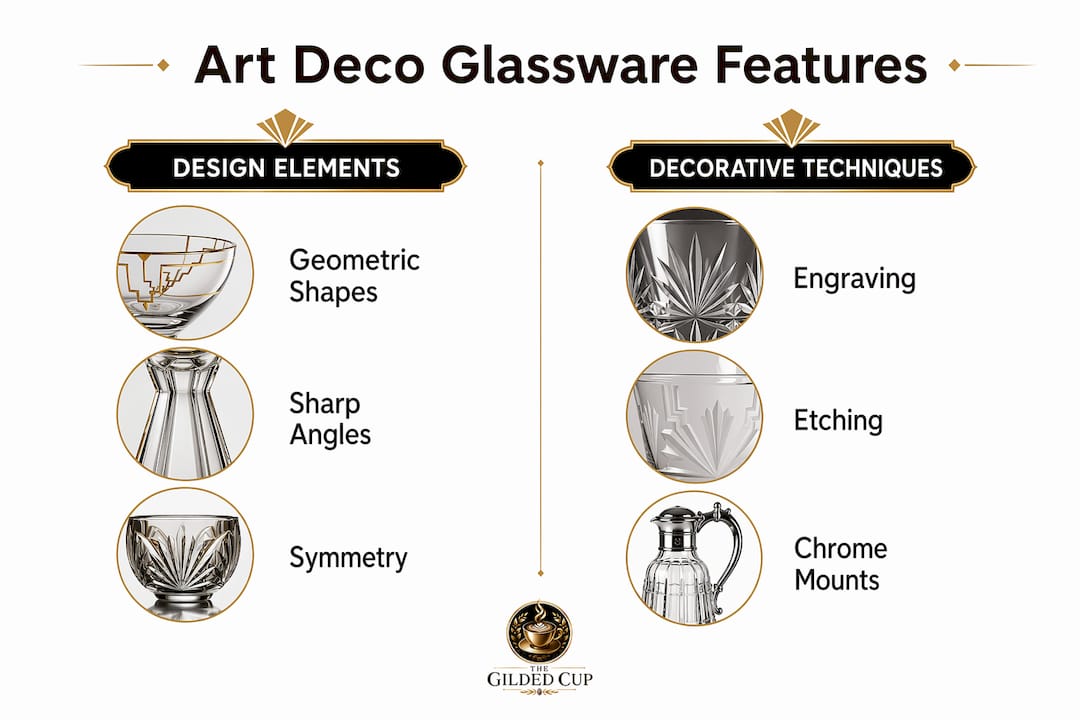
- Geometric shapes: Hexagons, chevrons, sunbursts, and stepped pyramidal forms appear across vases, decanters, and stemware.
- Symmetry: Bilateral balance is nearly universal. If one side has a motif, the other mirrors it exactly.
- Sharp angles and stepped forms: Tiered or terraced profiles, sometimes called “ziggurat” shapes, reference both ancient architecture and modernist ideals.
- Surface finishes: Frosted, etched, engraved, and molded relief surfaces are standard. Polished clear glass is often used in contrast to matte areas to create visual tension.
- Color palette: Deep ambers, cobalt blues, smoky grays, and clear crystal dominate. Some makers used colored overlays or cased glass for added depth.
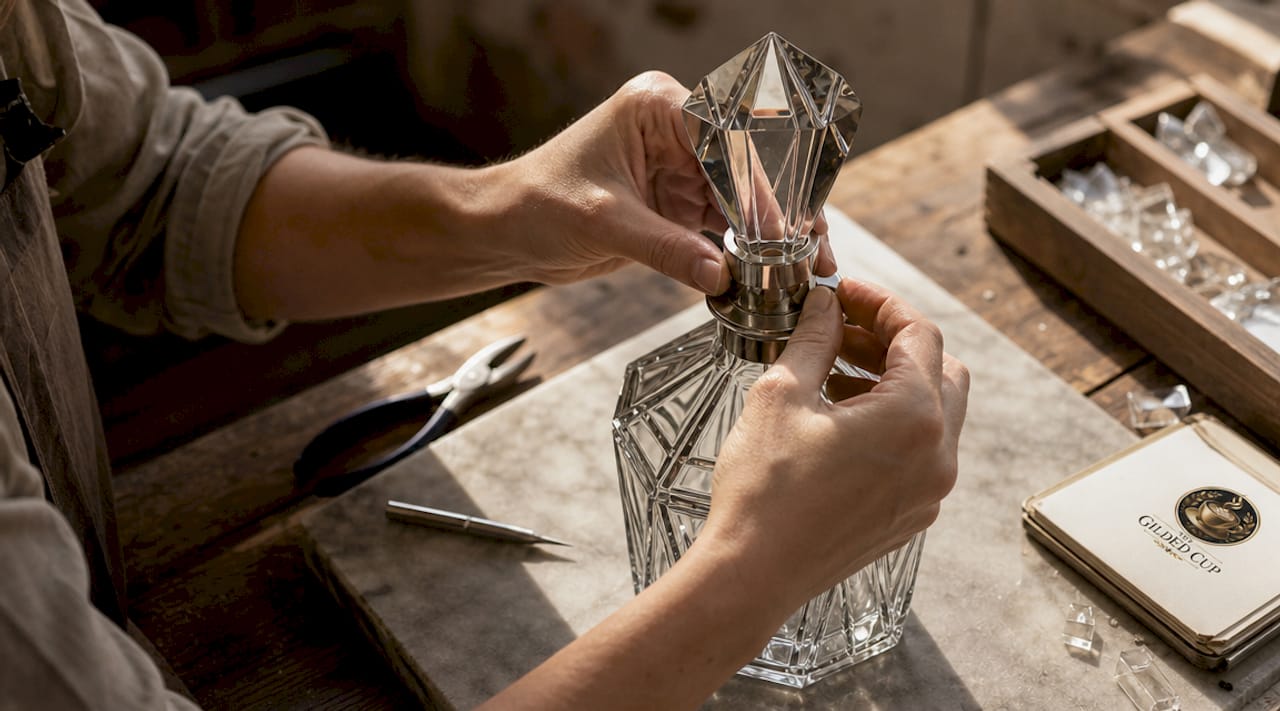
Industrial influence is visible throughout. Chrome plating on metal mounts, geometric stoppers on decanters, and the use of pressed or molded glass for mass production all reflect the era’s fascination with machine aesthetics. This is what separates Art Deco from earlier decorative styles: it did not resist industry. It absorbed it. The result was art fused with industrial design, balancing handcrafted artistry with the efficiency of modern manufacturing.
Pro Tip: When examining a piece for the first time, look at the silhouette before the surface. A stepped or angular profile is the fastest indicator of Art Deco origin, even before you assess any decorative technique.
How are engraving and etching used in Art Deco glass decoration?
Understanding the decorative techniques is the difference between admiring Art Deco glassware and truly reading it. The three primary cold decoration methods are engraving, etching, and cutting, and each produces a distinct visual result.
- Wheel engraving: A rotating wheel, traditionally copper with linseed oil and fine emery powder and now more commonly stone or diamond-tipped, cuts shallow incised marks into the glass surface. The result is typically a frosted, matte finish that scatters light rather than reflecting it. Engraved areas appear soft and luminous against polished clear glass.
- Diamond-point engraving: A diamond-tipped tool scratches fine lines directly onto the surface. This technique produces delicate, precise detail and is often used for signatures or intricate geometric patterns. Diamond-point work can help authenticate and date a piece, since the tool marks are distinctive under magnification.
- Acid etching: Hydrofluoric acid or acid-resistant paste is applied to the glass surface, either directly or through a resist stencil, to create frosted or recessed areas. Etching produces softer, more diffuse effects than wheel engraving and was widely used for repeating geometric patterns across Art Deco production pieces.
- Cut glass: A harder, deeper process using abrasive wheels to remove significant glass material, creating sharp facets that refract light brilliantly. Cut glass is often confused with engraving, but the depth and reflective quality are noticeably different.
Many Art Deco pieces combine multiple techniques on a single object. A vase might feature acid-etched geometric banding with wheel-engraved floral motifs at the center, all on a form with cut facets at the base. This layering of techniques is a hallmark of high-quality production from studios like Daum Frères, where layered glass and varied surface textures required careful planning to control how light filtered through multiple decorative zones.
Pro Tip: Hold a piece up to a single light source and rotate it slowly. Engraved areas will glow with a soft, diffuse luminosity. Etched areas will appear uniformly matte. Cut facets will throw sharp, bright reflections. This simple test reveals the decoration map of any piece without any tools.
How to identify authentic Art Deco glassware
Authentic identification requires looking at design grammar, manufacturing evidence, and provenance together. No single cue is definitive on its own.
Design grammar: geometry and motifs
Art Deco motifs maintain strict geometry and repetition. Floral designs do appear, but they are stylized into angular or stepped forms rather than the free-flowing botanical curves of Art Nouveau. A rose in Art Deco looks like a geometric abstraction of a rose. In Art Nouveau, it looks like an actual rose. This distinction is the fastest visual shortcut for collectors.
| Feature | Art Deco | Art Nouveau |
|---|---|---|
| Line quality | Sharp, angular, geometric | Sinuous, organic, flowing |
| Motifs | Stylized geometry, stepped forms | Natural botanicals, insects, female figures |
| Symmetry | Strict bilateral balance | Asymmetry common |
| Surface finish | Frosted, etched, molded relief | Painted enamel, naturalistic carving |
| Color approach | Bold contrasts, clear and matte | Soft gradients, naturalistic tones |
Manufacturing marks and provenance
Genuine Art Deco pieces from major makers carry identifiable marks. René Lalique signed pieces with “R. Lalique” before 1945 and “Lalique France” after. Val Saint Lambert used acid-etched or engraved marks on crystal. Daum pieces carry the “Daum Nancy” signature, often with the Cross of Lorraine. The absence of a mark does not disqualify a piece, since many smaller workshops produced unsigned work, but a mark significantly supports authentication.
Common misidentifications include:
- Calling pressed glass “cut glass” because of its faceted appearance
- Confusing 1950s modernist glass with 1930s Art Deco due to shared geometric vocabulary
- Mistaking reproduction pieces for originals based on design alone without examining manufacturing quality
Collectors value manufacturing techniques and decorative textures as core indicators of authenticity. A piece with genuine wheel-engraved detail will show slight irregularities under magnification. Reproduction pieces using acid-etched stencils produce perfectly uniform patterns that lack the subtle variation of hand work. Patina on authentic vintage glass, including micro-scratches, slight cloudiness in recessed areas, and the natural aging of any metal mounts, also supports genuine age. You can learn more about reading these surface changes in Thegildedcup’s guide to glassware patina.
Popular Art Deco glassware designs and notable makers
The history of Art Deco glass is inseparable from a handful of studios and designers who defined its visual language.
René Lalique is the most recognized name in Art Deco glass. His work emphasized contrasts of transparent and frosted glass, using the interplay of clear and matte surfaces to create objects that seemed to generate their own light. His vases, perfume bottles, and car mascots remain among the most sought-after Art Deco glass objects in the world.
Daum Frères, based in Nancy, France, made one of the most significant transitions in the history of Art Deco glass. The Nancy glassmakers shifted from naturalistic Art Nouveau to geometric and symmetrical Art Deco forms while maintaining their technical mastery of layered glass and varied surface effects. Their interwar pieces combine cased glass construction with acid etching and wheel engraving in ways that remain technically impressive today.
Val Saint Lambert, the Belgian crystal house, produced geometric crystal patterns and advanced cutting techniques that placed it at the center of Art Deco glassware’s industrial and artistic development between 1925 and 1939. Their stemware and decanters feature sharp-line cutting combined with floral geometry that reads as distinctly Art Deco even at a distance.
Bohemian Loetz pioneered the metallic iridescent surface effects of the Phänomen series, using fused glass threads and metallic oxides to produce hallmark iridescence. While Loetz is more closely associated with the transition from Art Nouveau, their technical experiments directly influenced the surface innovation that defined Art Deco glass production.
Popular motifs across all makers include sunburst patterns, stepped architectural forms, stylized fauna, geometric banding, and faceted cuts that create prismatic light effects. These are the popular Art Deco glass designs you will encounter most frequently in auction catalogs and estate sales.
How collectors and decorators can use Art Deco glassware today
Art Deco glassware functions equally well as a display object and as functional drinkware or serving ware. The key is understanding how light and placement affect the visual reading of each piece.
Frosted and etched surfaces perform best under warm, directional light. A single lamp placed behind or beside a frosted vase will cause the engraved areas to glow. Overhead fluorescent lighting flattens the surface and eliminates the contrast that makes these pieces compelling. Lighting conditions significantly affect the visual reading of engraved and etched glass, which means display placement is as much a design decision as the piece itself.
Practical care considerations for your collection:
- Hand wash only. Dishwashers damage frosted and etched surfaces by abrading the fine texture that creates the matte effect.
- Avoid alkaline cleaners on engraved or etched areas. Use mild dish soap and lukewarm water. Thegildedcup’s guide to luxury glassware cleaning covers the specific steps for preserving decorated surfaces.
- Store pieces with soft padding between them. The raised relief on molded Art Deco glass can chip against other hard surfaces.
- Document provenance. Photographs, receipts, and any accompanying paperwork add measurable value to a collection over time.
Mixing Art Deco glassware with contemporary interiors works well because the geometric vocabulary of Art Deco reads as modern rather than antique. A Lalique-style frosted vase on a minimalist shelf, or a set of geometric crystal decanters on a bar cart, bridges the 1930s and the present without visual conflict. The emotional and aesthetic impact of genuine Art Deco glass in a room is difficult to replicate with reproductions.
Pro Tip: If you are building an Art Deco glassware collection on a budget, start with unsigned production pieces from known regional workshops rather than chasing signed Lalique. The design quality is often comparable, the prices are significantly lower, and the pieces are just as instructive for developing your eye.
Key takeaways
Art Deco glassware is identified by its geometric design grammar, cold decorative techniques like engraving and etching, and the work of specific makers including René Lalique, Daum Frères, and Val Saint Lambert.
| Point | Details |
|---|---|
| Geometric design grammar | Sharp angles, stepped forms, and strict symmetry define Art Deco glass at a glance. |
| Decorative technique variety | Engraving, etching, and cutting each produce distinct light effects and require different identification approaches. |
| Maker signatures matter | Lalique, Daum, and Val Saint Lambert marks significantly support authentication and valuation. |
| Light drives display decisions | Warm, directional lighting reveals the full visual impact of frosted and etched surfaces. |
| Care preserves value | Hand washing and soft storage protect the decorated surfaces that define a piece’s authenticity and worth. |
Why Art Deco glass still earns its place on the shelf
I have handled a lot of glass over the years, and Art Deco pieces consistently do something that most other decorative styles do not: they reward sustained attention. The first impression is the geometry. The second impression, once you hold a piece up to the light, is the surface. The third impression, once you understand the technique, is the craft. That three-layer reveal is rare in decorative objects.
What I find underappreciated is how much the industrial context matters to understanding these pieces. Art Deco glass was not made despite the machine age. It was made because of it. Studios like Val Saint Lambert and Daum were not retreating from modernity. They were absorbing it, translating factory precision into objects that still felt handmade and personal. That tension is what gives the best Art Deco glass its character.
The collector mistake I see most often is over-relying on motifs and under-relying on technique. Two pieces can share identical geometric patterns and be separated by decades and continents of production. The decoration technique, the weight of the glass, the quality of the engraving, and the evidence of age are what separate a genuine 1930s piece from a competent reproduction. Develop your eye for technique first. The motifs will follow.
— Sharbel
Explore Art Deco glassware at Thegildedcup
Thegildedcup curates a selection of vintage and collectible glassware for collectors and decorators who want pieces with genuine history behind them. Whether you are building your first Art Deco glassware collection or adding to an established one, the platform offers detailed product descriptions, high-quality photography, and the context you need to make confident decisions.

For collectors starting out, Thegildedcup’s guide to vintage glassware identification is a practical first step. For those focused on specific makers and heritage brands, the heritage glass brands guide provides the brand-level context that separates informed buying from guesswork. Browse the full collection at Thegildedcup and find pieces that hold their value and their beauty.
FAQ
What is Art Deco glassware?
Art Deco glassware refers to glass objects produced primarily in the 1920s and 1930s, defined by geometric forms, symmetry, sharp angles, and decorative techniques including engraving, etching, and molded relief. It contrasts directly with the organic curves of Art Nouveau.
How do I identify Art Deco glass?
Look for strict geometric symmetry, stepped or angular profiles, and cold decoration techniques like wheel engraving or acid etching. Maker signatures from studios such as René Lalique, Daum Nancy, or Val Saint Lambert further confirm authenticity.
What is the difference between engraving and etching on Art Deco glass?
Engraving uses a rotating wheel or diamond point to cut shallow incised marks that appear frosted and luminous. Etching uses acid or abrasive paste to create matte surface effects. Many Art Deco pieces combine both techniques on a single object.
Who are the most important Art Deco glassware makers?
René Lalique, Daum Frères, Val Saint Lambert, and Bohemian Loetz are the most significant names. Each studio developed a distinct technical and aesthetic approach that shaped the broader Art Deco glass movement.
How should I care for Art Deco glassware?
Hand wash with mild soap and lukewarm water. Avoid dishwashers and alkaline cleaners, which damage frosted and etched surfaces. Store pieces with soft padding between them to protect raised relief decoration from chipping.